Indoor Cat Enrichment: 15 Ideas to Keep Your Cat Stimulated and Happy
Indoor Cat Enrichment: 15 Ideas to Keep Your Cat Stimulated and Happy
Indoor cats are safer, live longer, and never bring half-dead mice into your bed at 3 a.m. But they also miss out on the sensory buffet the outside world offers: rustling leaves, stalking prey, climbing trees, patrolling territory. Without deliberate indoor cat enrichment, many cats slide into boredom—and bored cats don't just sleep more. They overeat, pick fights with the dog, yowl at dawn, or chew your houseplants down to nubs.
We've watched our own cats transform when we added structured play and environmental variety. A once-lethargic tabby became an acrobat after we installed wall shelves. A compulsive groomer stopped overgrooming when we introduced hunt-and-feed routines. Enrichment isn't about buying every gadget on the market—it's about understanding what your cat's brain and body actually need.
Why Indoor Cats Get Bored (And Why It Matters)
Cats are crepuscular hunters hardwired to stalk, pounce, and patrol. In the wild, a cat might have dozens of micro-hunts per day. Indoors, if you free-feed kibble from a bowl and don't offer outlets for those instincts, your cat's day looks like this: sleep, eat, sleep, groom, sleep, stare out the window, sleep.
Cat boredom manifests in ways owners often miss. Overeating and weight gain top the list—many indoor cats eat because there's simply nothing else to do. Others become destructive, knocking objects off counters or shredding furniture not out of spite, but because they're under-stimulated. Some get vocal, yowling persistently, especially at night. A few turn their frustration inward, overgrooming until bald patches appear.
We're not saying every indoor cat needs a full-time job. But they do need daily opportunities to hunt (even if it's fake prey), climb, hide, and problem-solve.
1. Vertical Space: Let Them Claim the High Ground
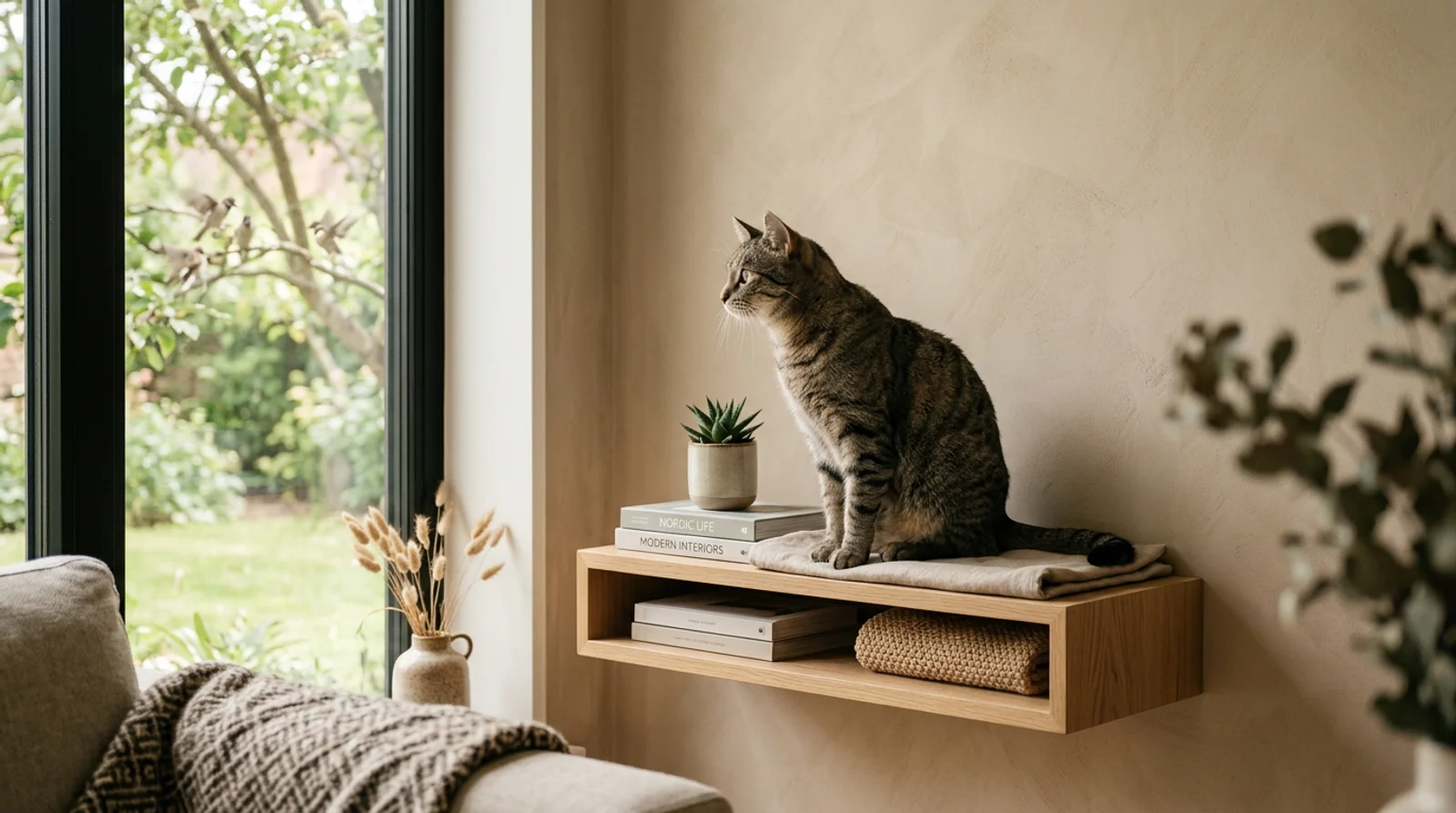
Cats feel safest when they can survey their territory from above. A cat tree, wall-mounted shelves, or even a cleared bookcase top gives your cat vertical real estate—and often solves territorial tension in multi-cat homes.
We've installed everything from DIY floating shelves to floor-to-ceiling cat towers in our own homes. The key is stability. A wobbly perch defeats the purpose. For a 5-kg Siamese, basic shelves work fine. For a 7-kg Maine Coon, reinforce brackets and test weight limits before installation.
Place vertical spaces near windows when possible. A cat who can watch birds and squirrels from a high perch gets free entertainment—though expect chirping and tail-twitching.
2. Rotate Toys to Keep Novelty High
Your cat's toy basket shouldn't be an all-you-can-eat buffet. When every toy is always available, none of them stay interesting.
We keep three bins: one in rotation, two in storage. Every week, we swap. Suddenly the crinkle ball that was ignored Tuesday becomes Friday's obsession. This trick works especially well with mice, springs, and anything that smells like catnip.
Don't toss worn toys too quickly. That ratty feather wand missing half its plumes? Often a favourite precisely because it smells like victory.
3. Interactive Cat Toys: The Hunt-and-Capture Cycle
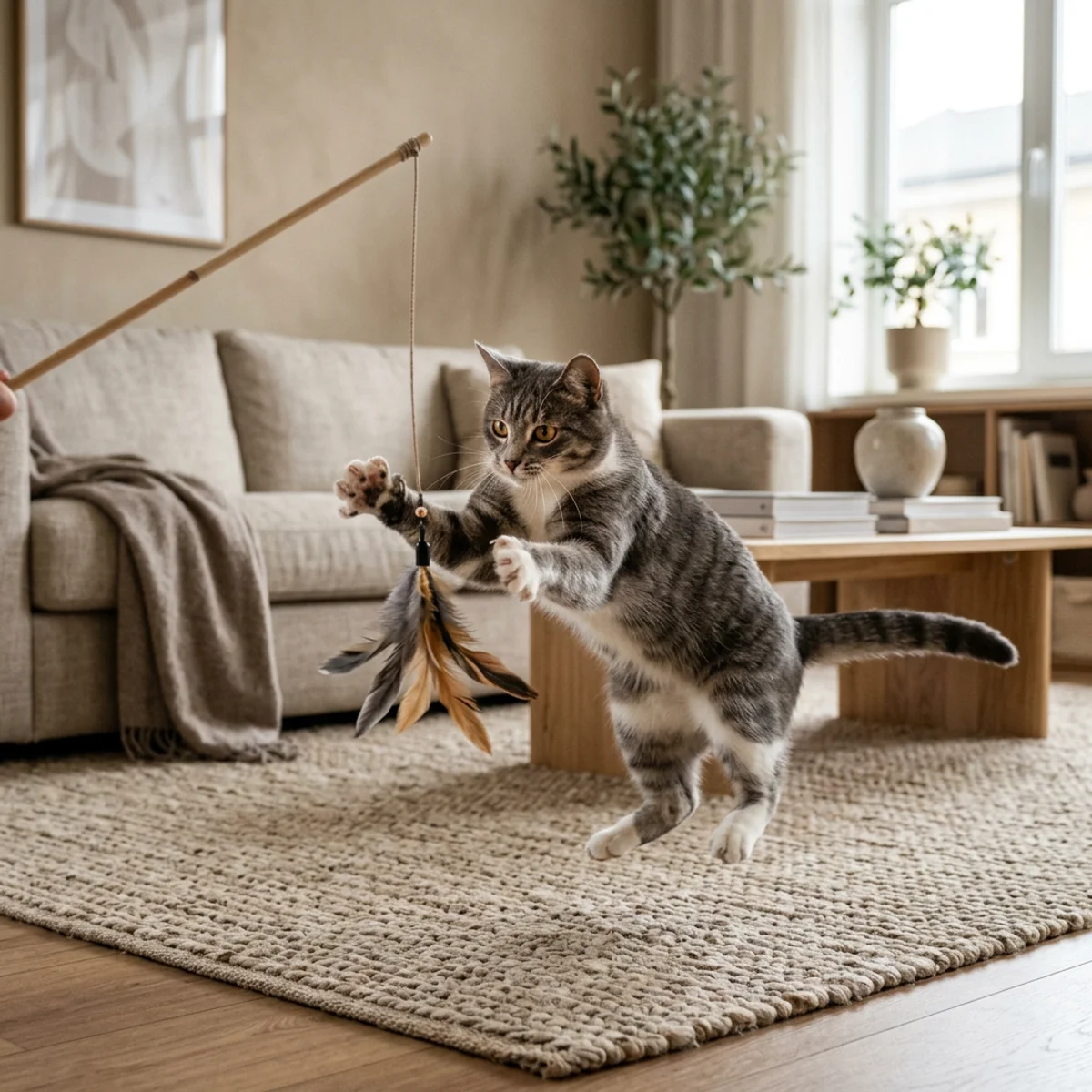
Static toys—a ball sitting on the floor—rarely hold a cat's attention. Interactive cat toys that mimic prey (erratic movement, rustling sound, something to chase and "kill") tap into hunting instinct.
Our go-to categories:
- Wand toys: feathers, ribbons, or fur on a string. You control the "prey," making it dart, flutter, and hide. Play until your cat catches and bites it—the capture is the reward.
- Motorized mice and birds: battery-powered toys that skitter or flutter unpredictably. Useful for solo play, though supervise the first few sessions.
- Laser pointers: controversial, but we use them with one rule: always end the session by leading the laser to a physical toy or treat your cat can actually catch. Never leave a cat without a tangible "kill."
Aim for two 10–15 minute play sessions daily—morning and evening align with cats' natural crepuscular hunting times. Adjust duration and intensity based on your cat's age, health status, and energy level. Consult your veterinarian if you have concerns about appropriate exercise levels for your cat.
4. Puzzle Feeders and Slow-Feed Bowls
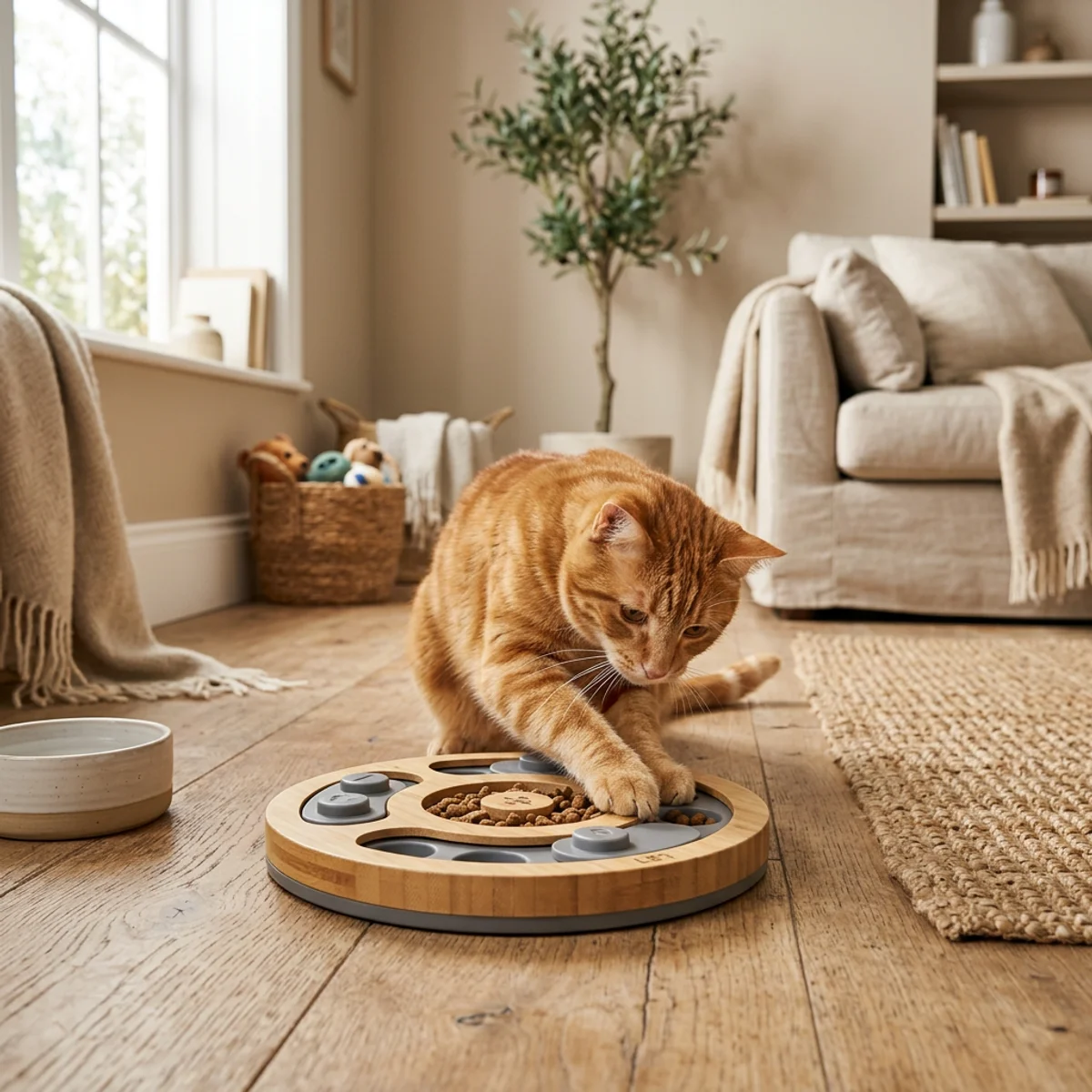
If your cat inhales meals in 30 seconds and begs for more, a puzzle feeder adds challenge and slows eating. These feeders make your cat work for kibble—pawing, nudging, or tilting to release food bit by bit.
Start simple. A basic slow-feed bowl with ridges or a ball that dispenses kibble as it rolls works for beginners. Once your cat understands the game, graduate to multi-chamber puzzles or treat mazes.
We've seen puzzle feeders reduce post-meal vomiting (from eating too fast) and keep food-motivated cats occupied for 20 minutes instead of 20 seconds. Not every cat takes to them immediately—if yours ignores it, place a few high-value treats on top to spark interest.
5. DIY Cat Enrichment: Cardboard Boxes and Paper Bags
You don't need a budget. Cats are happiest with the simplest things—if those things are new.
A cardboard box becomes a fort, hunting blind, or nap cave. Cut holes in the sides for peek-a-boo games or toss a jingle ball inside. Crumpled paper bags (handles removed, never plastic) are instant toys. The crinkle sound alone captivates.
We rotate cardboard forts every few weeks. When a box gets tatty, flatten it and bring in a new one. Fresh box smell is apparently intoxicating.
6. Window Perches and Bird TV
A window with a view is your cat's Netflix. Mounting a padded perch or hammock at window height gives your cat hours of passive entertainment—watching birds, squirrels, traffic, and weather.
For maximum effect, place a bird feeder or birdbath outside the window (a few metres away, so birds feel safe). We've done this at our studio and it's borderline addictive for cats. Expect chittering, tail lashing, and intense focus.
If your windows lack wildlife, try cat-specific videos on a tablet—videos of birds, fish, or mice trigger prey drive. Some cats ignore screens entirely; others become glued.
7. Scratching Posts in Strategic Locations
Scratching isn't destructive—it's maintenance (claw shedding), territory marking, and a full-body stretch. Cats without proper scratch surfaces will often use your furniture. Scratching is a natural, necessary behavior for claw health, territorial marking, and stress relief—not a behavioral problem to eliminate, but an instinct to redirect appropriately.
Place scratchers where your cat already wants to scratch: near sleeping areas (cats stretch after naps), by entry points, and in social zones. Offer variety—vertical posts, horizontal pads, angled ramps—because cats have preferences.
Material matters. Sisal rope and corrugated cardboard are favourites. Carpet-covered posts often fail because the texture resembles your actual carpet, and cats don't distinguish.
If your cat ignores a new post, rub it with catnip or silvervine, or place treats on top.
8. Hide-and-Seek Feeding Games
Instead of bowl-feeding breakfast, hide small piles of kibble around the house. Tuck portions on a cat tree platform, inside a cardboard box, behind a chair leg, on a windowsill.
This mimics foraging and turns mealtime into a scavenger hunt. It's especially useful for multi-cat homes where one cat inhales food while another grazes—hidden feeding lets the slower eater find private stashes.
Start easy (kibble in plain sight) and increase difficulty as your cat learns the game.
9. Catnip, Silvervine, and Valerian: Stimulants That Work
About 50-70% of cats react to catnip (it's genetic). For cats who don't respond, try silvervine or valerian root—studies show that silvervine in particular can elicit responses in cats that don't react to catnip.
We refresh catnip toys every month because potency fades. Store loose catnip in a sealed container in the freezer to preserve oils.
Not all cats need chemical enrichment, and some become overstimulated or aggressive. If your cat gets too rowdy, skip it.
10. Cat Exercise Indoors: Fetch, Chase, and Climb
Yes, some cats fetch. Abyssinians, Siamese, and Bengals often retrieve toy mice or crumpled paper balls. If your cat brings toys back to you, capitalize on it—it's excellent cat exercise indoor and bonding.
For high-energy breeds (Bengals, Savannahs), consider a cat wheel. They look like oversized hamster wheels and some cats genuinely run on them. They're expensive and take up space, but for the right cat, they're transformative.
Climbing circuits—linking shelves, cat trees, and furniture into a vertical highway—also burn energy and satisfy the urge to patrol.
11. Social Enrichment: Playdates and Companionship
Cats are not strictly solitary. Many thrive with a feline companion, especially if they're young or highly social.
If your cat seems lonely (follows you everywhere, vocalizes excessively when alone), consider adopting a second cat. Introductions must be gradual—weeks, not days—to avoid territorial aggression. A kitten or young cat with similar energy often works best.
Not every cat wants a roommate. Older cats or those with a history of aggression may prefer being solo. Read your individual cat.
12. Scent Enrichment: Bring the Outdoors In
Cats experience the world through scent as much as sight. Bringing in safe, novel smells adds sensory variety.
Try placing a small branch (pesticide-free) in a corner for your cat to sniff and rub against. Rotate it weekly. Some owners sprinkle small amounts of dirt or leaves (again, pesticide-free) in a shallow box for supervised exploration.
Herbs like cat thyme or fresh wheatgrass offer safe, interesting scents. We grow wheatgrass on our windowsill—cats nibble it and it's safe (unlike many houseplants, which are often toxic). While some believe it aids digestion, consult your veterinarian about dietary supplements and ensure any plants accessible to your cat are non-toxic.
13. Clicker Training and Trick Teaching
Cats can learn tricks—sit, high-five, spin, even retrieve—using clicker training and treats. The mental challenge is enrichment in itself, and it strengthens your bond.
Start with something simple: click and treat when your cat sits naturally. Repeat until they associate the click with reward. Then shape the behaviour by clicking only when they sit on cue.
Some cats lose interest quickly. Keep sessions short (5 minutes) and end on success. High-value treats (freeze-dried chicken, tuna flakes) improve motivation.
Use high-value but small treats, and account for training treats in your cat's daily caloric intake to prevent weight gain. Consult your veterinarian about appropriate treat portions for your cat's size and health status.
14. Rotate Resting Spots and Hideaways
Cats are den animals—they need cozy, enclosed spaces to feel secure. Offer variety: a covered bed, a tunnel, a paper bag fort, a laundry basket with a towel.
Rotate these every few weeks. Moving a cat bed from the living room to the bedroom makes it "new" again.
In multi-cat homes, ensure there are more resting spots than cats, spread across different rooms and heights. This reduces competition and stress.
15. Supervised Outdoor Time: Catios and Leash Walks
If you can offer safe outdoor access, it's the ultimate enrichment. A catio (screened porch or enclosed balcony) lets your cat experience fresh air, sun, and outdoor sights and smells without danger.
Some cats tolerate harness and leash walks. Start indoors, getting your cat comfortable wearing the harness (use treats and patience—this can take weeks). Once they're relaxed, try short sessions in a quiet yard. Never force it. Some cats love leash walks; others panic.
Outdoor time isn't necessary for a happy cat, but for the right temperament, it's gold.
FAQ
How much enrichment does an indoor cat actually need?
At minimum, two interactive play sessions per day (10–15 minutes each) plus environmental variety—vertical space, scratching posts, and rotated toys. High-energy breeds like Bengals or young kittens need more. Senior cats need gentler, but still regular, stimulation.
My cat ignores every toy I buy. What am I doing wrong?
You're probably offering too many at once, or the toys aren't mimicking prey correctly. Try rotating toys so only a few are available at a time. Use wand toys that YOU animate—most cats won't chase a static ball, but they'll hunt a feather you make "fly." Also check that play sessions align with dawn and dusk, when cats are naturally active.
Can I leave my cat alone all day if I provide enrichment?
Yes, most adult cats handle 8–10 hour stretches alone if their environment is enriched and you provide active play morning and evening. Kittens under six months and highly social breeds (Siamese, Ragdolls) struggle more with isolation. Puzzle feeders, window perches, and background noise (radio or cat TV) help. If your cat is destructive or overly vocal when alone, they may need more stimulation—or a companion.
Is it okay to use a laser pointer with cats?
We use them cautiously. The problem with laser pointers is that cats never "catch" the prey, which can cause frustration. Our rule: always end a laser session by leading the dot to a physical toy or treat your cat can pounce on and bite. That tangible reward completes the hunt cycle. Never shine the laser in your cat's eyes, and don't use it with cats who become obsessive or anxious.
Enrichment Is Maintenance, Not Extra
Treating indoor cat enrichment as optional is like skipping oil changes and wondering why the engine sputters. Cats are hunters in a house. They need outlets for those instincts, or the energy finds less desirable exits.
You don't need to implement all fifteen ideas tomorrow. Start with two or three—vertical space, interactive play, and puzzle feeding are our top recommendations—and build from there. Watch what your individual cat responds to. The Maine Coon who ignores feather wands might obsess over a motorized mouse. The senior tabby who won't climb might love a scent-enriched box at ground level.
Browse our curated collection of interactive toys, puzzle feeders, and thoughtfully designed cat furniture—we've tested everything with our own cats and stock only what actually works.