Best Interactive Cat Toys to Keep Your Cat Engaged & Active
Best Interactive Cat Toys to Keep Your Cat Engaged & Active
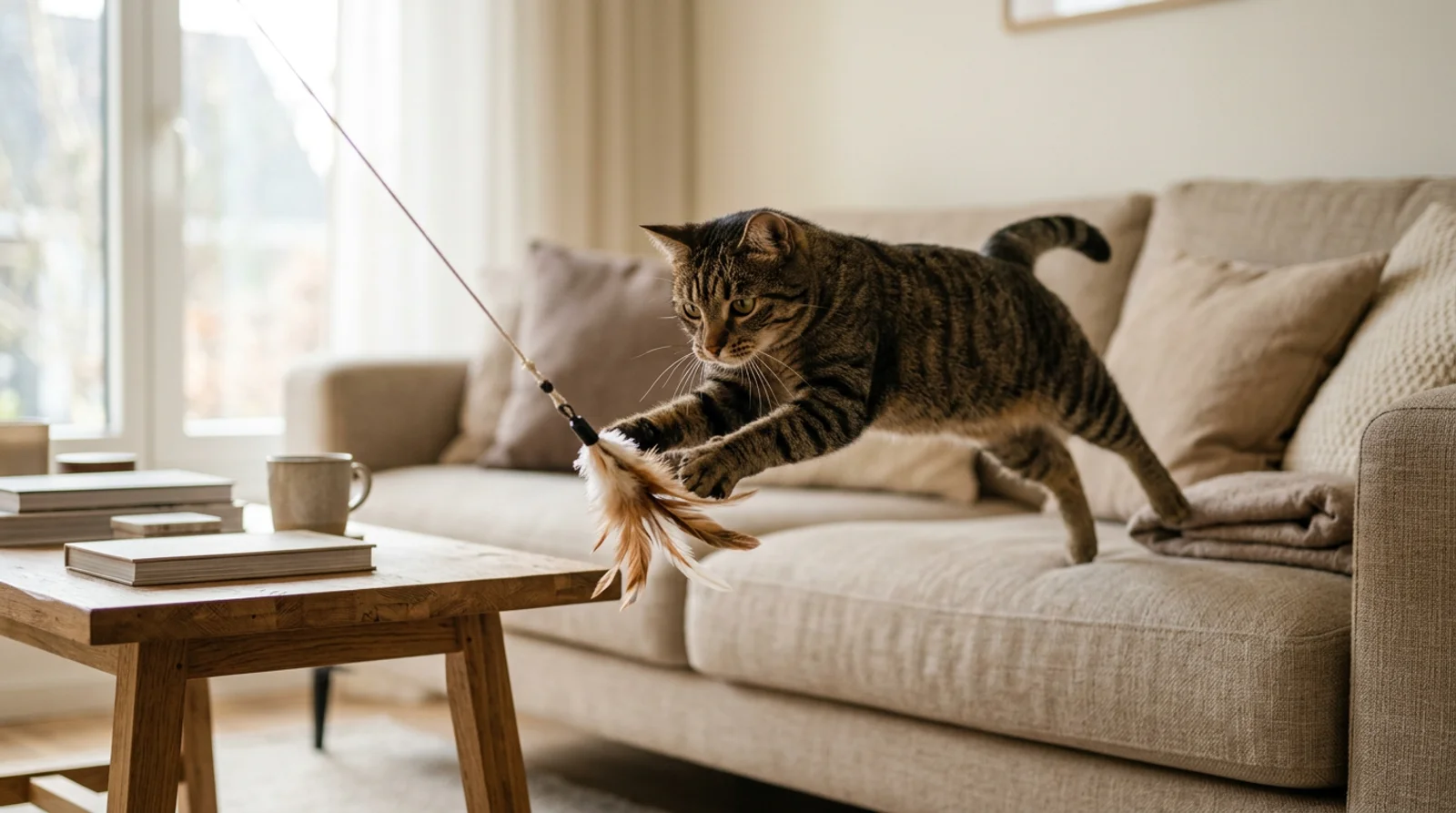
The best interactive cat toys turn bored nappers into focused hunters. We're talking puzzle feeders that make mealtime a 10-minute brain workout, motorized mice that trigger genuine stalking behaviour, and wand toys that get even the laziest senior airborne. After years of testing toys on our own cats—and watching a food-obsessed tabby transform from couch potato to puzzle-solving athlete—we know what actually works and what ends up ignored under the sofa.
Indoor cats need jobs. Without birds to stalk or mice to chase, many develop behavioural problems: overeating, destructive scratching, 3 a.m. zoomies, aggression toward other pets. Interactive toys bridge that gap, offering the mental stimulation and physical activity that tire out both brain and body. Our own cats are proof. After 20 minutes with a good puzzle feeder or wand session, they're content to nap instead of shredding the sofa or yowling at dawn.
Why Interactive Toys Matter for Cat Enrichment
Cats are obligate carnivores hardwired to hunt. In the wild, they'd spend hours stalking, pouncing, and problem-solving to secure a meal. A bowl of kibble delivered twice daily? That takes five seconds and zero effort. The result is an under-stimulated cat with pent-up energy and a mind-numbing routine.
Interactive toys restore that cognitive challenge. Puzzle feeders force cats to paw, nudge, and strategize for each bite. Automated toys keep prey "alive" even when you're at work. Wand toys let you control the hunt, teaching your cat to stalk, chase, and leap on cue. We've watched anxious cats calm down and lethargic seniors perk up once their days included regular enrichment.
Cats also need variety. A toy that captivates today might bore them next week—they're notoriously fickle. Rotating a small collection of interactive toys keeps novelty high and prevents the dreaded "I've seen it all" indifference. For more ideas on keeping indoor cats engaged, see our guide to indoor cat enrichment ideas.
Puzzle Feeders and Food-Dispensing Toys
Puzzle feeders are our top recommendation for every cat household. They slow down fast eaters, add mental stimulation to mealtime, and satisfy the urge to "work" for food. Even cats who've never hunted a day in their lives take to these quickly—instinct kicks in fast.
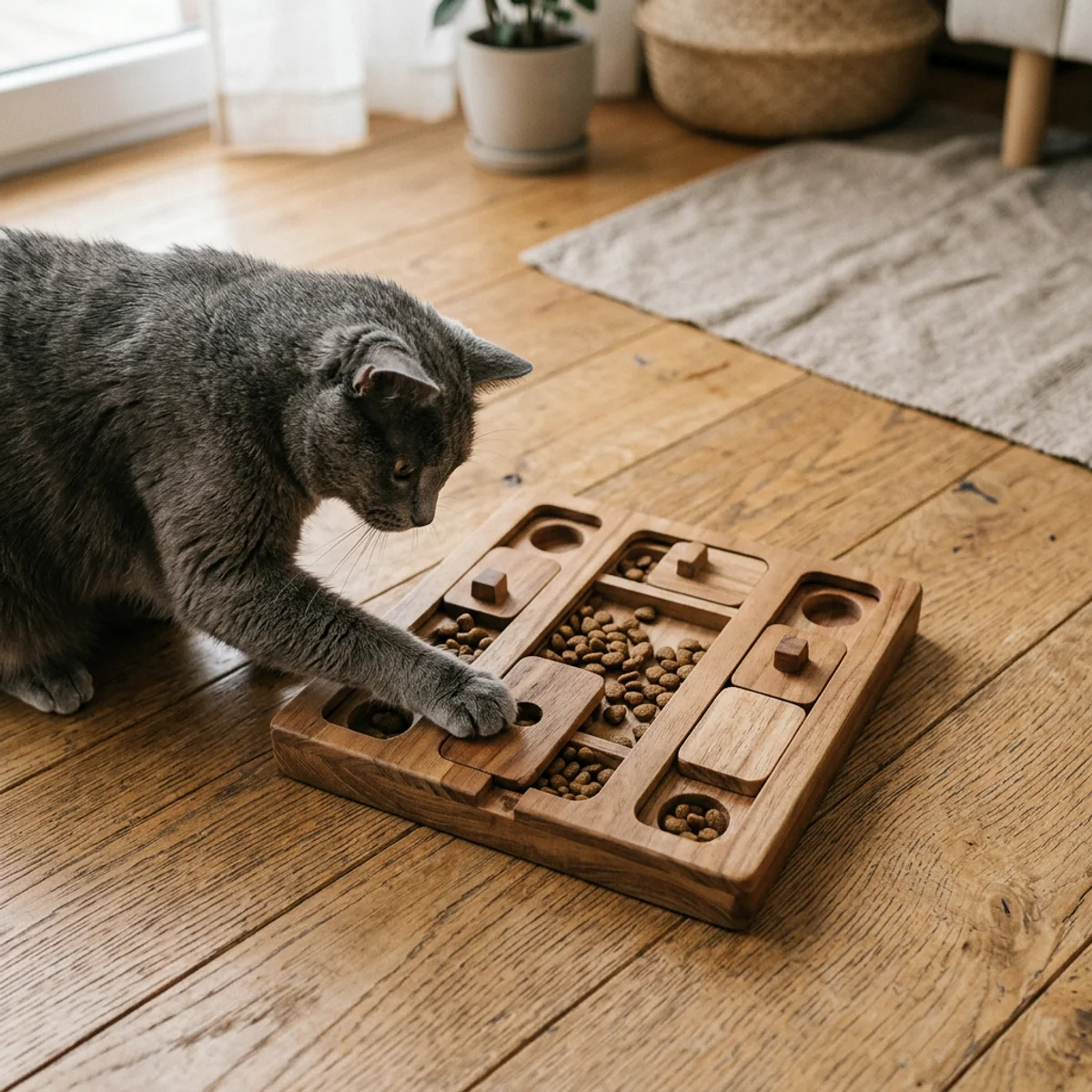
Stationary puzzle feeders have compartments, tunnels, or mazes that hide kibble or treats. Cats must fish out each piece with their paws. These work beautifully for measured meals or slow feeding. We use one for our cat who used to inhale dinner and vomit ten minutes later. Look for feeders with adjustable difficulty—start easy, then increase the challenge as your cat masters each level.
Rolling treat balls dispense kibble as your cat bats them around the room. They combine problem-solving with cardio, ideal for cats who need to shed a few grams. (For more on healthy weight, check our cat weight management guide.) The caveat: these work best on hard floors. Carpet slows the roll and frustrates some cats.
Snuffle mats and foraging boards mimic hunting in grass or leaf litter. Scatter kibble in the fabric folds or wooden pegs, and let your cat sniff and paw it out. Our 14-year-old senior, who ignores most toys, will spend 15 minutes at her snuffle mat. It's low-impact enrichment perfect for older or less mobile felines.
Tips for Introducing Puzzle Feeders
- Start simple. If your cat has never used a puzzle feeder, choose one with large openings and minimal steps. Success builds confidence.
- Use high-value treats first. Freeze-dried salmon or chicken makes the effort irresistible while they learn.
- Don't remove the regular bowl immediately. Offer the puzzle feeder alongside their usual dish for a few days, then transition fully once they're hooked.
- Supervise early sessions. Some cats get frustrated and need encouragement; others dive right in.
Automated Cat Toys for Solo Play
Automated toys keep the hunt going even when you're busy. They're not a replacement for hands-on play—nothing beats a human-controlled wand—but they're brilliant for solo entertainment and midday boredom busting.
Automated laser toys project a moving red dot in random patterns across walls and floors. Cats love the chase, and the unpredictability keeps them engaged. We run ours for 10-minute sessions twice a day; it's enough to tire out our younger cat without overstimulating her.
One important note: always end laser play by directing the dot to a physical toy your cat can "catch." Lasers frustrate cats because they never get the satisfaction of a successful hunt. We toss a catnip mouse at the end of every session so our cats feel like they've won.
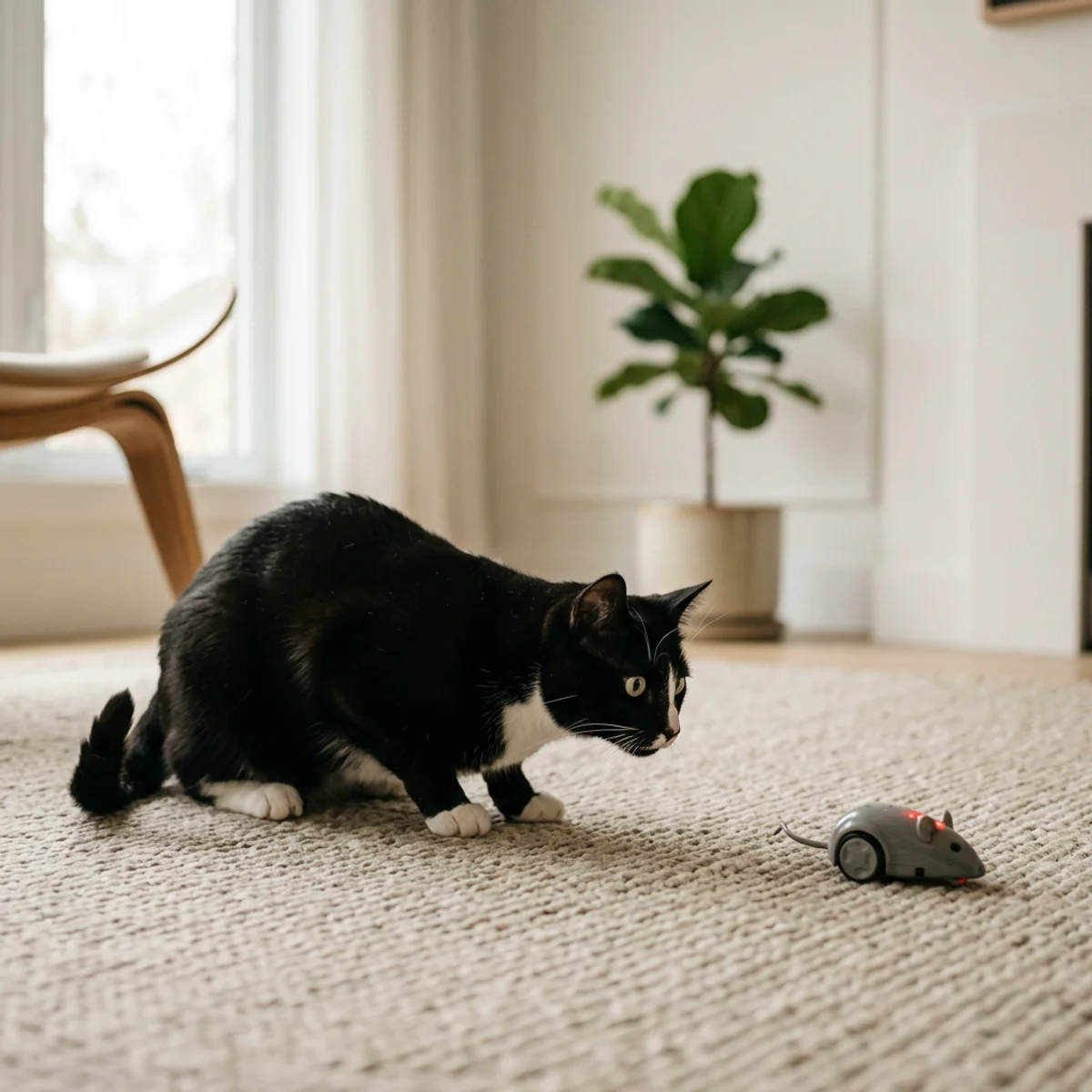
Interactive robotic toys—mice, feather wands, rolling balls—move on their own, switching direction when they hit obstacles. The best ones have irregular motion. Prey doesn't move in perfect circles. Our tabby stalks his robotic mouse like it's a genuine threat; it's the only toy that gets him into a proper crouch-and-wiggle.
Electronic flutter toys mimic birds or insects with feathers or fabric "wings" that twitch and spin under a fabric cover. Cats paw at the movement, and the toy responds with more erratic motion. These are magic for cats with a high prey drive but less effective for laid-back personalities.
What to Look For in Automated Toys
- Automatic shut-off. Toys that run indefinitely lose novelty fast. A 10–15 minute timer keeps play sessions sharp.
- Replaceable parts. Feathers and strings wear out. Choose toys with accessible refills.
- Quiet motors. Loud buzzing scares timid cats and annoys humans. Test volume before you buy if possible.
- Safety features. No small detachable parts, no exposed batteries. If your cat is a chewer, skip anything with thin plastic or fabric they can shred and swallow.
Wand Toys and Teaser Toys for Interactive Play
Wand toys are the gold standard for stimulating cat toys. They let you control speed, direction, and height, simulating real prey behaviour in ways no battery-operated toy can match. We consider these non-negotiable—every cat household should have at least two.
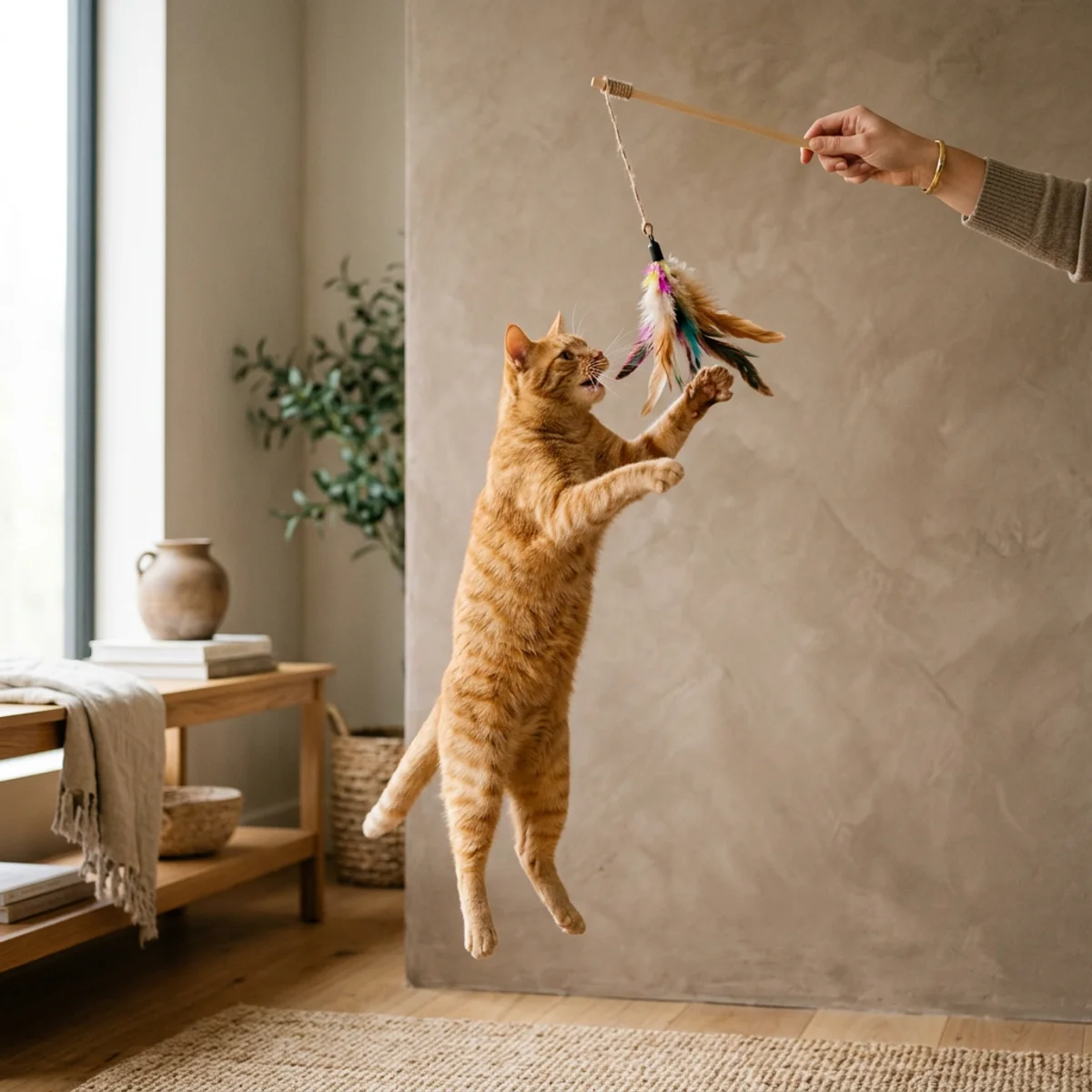
A good wand has a sturdy handle (at least 30 cm long to keep your hands out of claw range), a flexible rod, and interchangeable lures: feathers, fabric strips, fur mice, or crinkle fish. The magic is in how you use it. Drag the lure slowly across the floor like a mouse. Flutter it in the air like a bird. Hide it behind furniture, then twitch it into view. Cats respond to movement patterns, not the toy itself.
Our play sessions follow a hunt structure: slow stalk, explosive chase, brief rest, repeat. We end every session with a "catch"—letting the cat pin the toy and chew it for a moment—followed by a small treat or meal. This satisfies the hunt-kill-eat cycle and prevents frustration.
Feather wands are best for aerial hunters—cats who leap and twist midair. Drag them across the ceiling or dangle them from a cat tree.
Ribbon or fabric wands work for ground stalkers. Our senior cat won't jump anymore, but she'll chase a silk ribbon snaking across the carpet for ten minutes straight.
Spring toys and teasers attach to doorways or cat trees and bounce when swatted. They're great for solo play but need supervision—some cats chew through elastic cords.
Wand Toy Safety
- Store wands out of reach. String and elastic are serious ingestion hazards. We hang ours in a closet after every session.
- Check for wear. Frayed string or loose feathers should be replaced immediately.
- Never leave a cat unattended with a wand toy. Even the most careful cat can get tangled or swallow a piece.
For more on safe play, our dog toy safety guide covers principles that apply to cats too—check materials, supervise, and inspect regularly.
Comparing Popular Interactive Toy Types
Here's how the main categories stack up for different needs:
| Toy Type | Best For | Pros | Cons |
|---|---|---|---|
| Puzzle feeders | Slow eating, mental stimulation | Combines mealtime + enrichment; suits all activity levels | Requires supervision at first; not exciting for some cats |
| Automated lasers | High-energy cats, solo play | Hands-free; great for cardio | Frustrating without a physical "catch" at the end |
| Robotic mice/balls | Cats who stalk and pounce | Realistic prey motion; keeps novelty high | Battery life; some cats lose interest quickly |
| Wand toys | Bonding, high-intensity play | Best simulation of real hunting; you control the action | Requires your active participation; storage needed |
| Treat-dispensing balls | Weight management, boredom prevention | Combines food motivation + exercise | Works best on hard floors; noisy |
| Electronic flutter toys | Cats with strong prey drive | Engaging, unpredictable motion | Can be loud; not suitable for anxious cats |
How Much Playtime Does Your Cat Need?
Most indoor cats need at least two 10–15 minute play sessions daily—one in the morning, one in the evening. Kittens and high-energy breeds (Bengals, Abyssinians, Siamese) often need more. Senior cats benefit from shorter, gentler sessions that keep joints mobile without overexertion.
Watch your cat's signals. Panting, flattened ears, or dilated pupils can mean overstimulation. If your cat walks away mid-session, respect that—forced play stresses them out. On the flip side, if your cat brings you toys, paces at dawn, or attacks your ankles, they're under-exercised and need more enrichment.
Rotate toys every few days to maintain novelty. We keep a bin of wand lures and swap them out weekly; the "new" feather wand is suddenly fascinating again. Pair play with feeding (hunt, catch, eat) to satisfy the full predatory sequence, and your cat will be calmer and happier.
If your cat seems stressed or isn't engaging with toys, read our article on cat stress signs and solutions for troubleshooting tips.
Creating a Balanced Toy Rotation
We recommend building a small collection that covers different play styles:
- One or two puzzle feeders (start with an easy model, add a harder one as skills improve).
- A wand toy with multiple lures (feathers, ribbon, mouse).
- An automated toy for solo play—laser, robotic mouse, or flutter toy.
- A treat-dispensing ball for food-motivated cats or weight management.
- Solo swat toys like springs, crinkle balls, or catnip mice for independent play.
Store half the collection and rotate every week or two. This keeps each toy feeling "new" and prevents your cat from tuning out. We also scatter a few toys in different rooms—cats love rediscovering a forgotten mouse under the sofa.
FAQ
How do I get my lazy cat interested in interactive toys?
Start with food motivation. Use a puzzle feeder for a portion of their daily kibble, or hide treats inside a cardboard box with holes cut in the sides. For wand toys, move the lure away from your cat slowly—fleeing prey triggers the chase instinct better than something waved in their face. If they still won't engage, try different lure types (some cats ignore feathers but go wild for fabric) or play at a different time of day. Early morning and dusk are peak hunting hours for most cats.
Are laser pointers bad for cats?
Laser pointers aren't inherently bad, but they can frustrate cats if used incorrectly. The problem is that cats never get to "catch" the laser, which can lead to obsessive behaviour or anxiety. Always end laser play by guiding the dot to a physical toy or treat your cat can pounce on and claim. Limit sessions to 5–10 minutes, and never shine the laser in your cat's eyes.
How often should I replace interactive toys?
Inspect toys weekly. Replace wand toy lures when feathers fall out or strings fray. Toss puzzle feeders if plastic cracks or edges become sharp. Automated toys typically last 6–12 months with regular use; replace them if motors fail or parts break. Treat-dispensing balls can last years if cleaned regularly. Rotating toys extends their lifespan and keeps cats interested longer than leaving everything out 24/7.
Can interactive toys help with nighttime zoomies?
Absolutely. Most nighttime zoomies are caused by pent-up energy. A vigorous 15-minute play session an hour before bedtime—wand toy or automated laser—followed by a small meal mimics the hunt-catch-eat-sleep cycle and helps cats settle. We do this with our younger cat every evening, and it's cut her 2 a.m. sprints by about 80%. Pair play with a consistent bedtime routine for best results.
Keep Your Cat Engaged and Thriving
The best interactive cat toys are the ones your cat actually uses. Start with one or two from different categories—a puzzle feeder and a wand toy are a solid foundation—and observe what captures your cat's interest. Some cats are food-driven and will obsess over puzzle feeders; others live for the thrill of a feather wand. There's no one-size-fits-all, and that's part of the fun.
Play isn't optional for indoor cats—it's essential. It prevents boredom, burns energy, sharpens their minds, and strengthens your bond. We've seen it turn anxious cats calm and lazy cats athletic. Invest a few minutes daily, rotate toys regularly, and watch your cat's personality blossom.
Browse our curated selection of interactive toys at Studio Bleuet and find the perfect fit for your feline's hunting style.