Cat Weight Management: How to Help Your Cat Maintain a Healthy Weight
Cat Weight Management: How to Help Your Cat Maintain a Healthy Weight
Last month, one of our team members watched her twelve-year-old tabby, Leo, attempt to leap onto the kitchen counter—and miss. He'd gained nearly a kilogram over the winter, and that small shift had already changed his mobility. Cat weight management isn't about aesthetics. It's about preserving the quality of life that lets your cat jump, play, groom comfortably, and avoid the cascade of health problems that follow obesity. If you're reading this, you probably already sense your cat could stand to lose a few hundred grams—or you simply want to prevent weight gain before it starts. The good news: even modest weight loss reverses many obesity-related risks, and you can achieve it with portion control, enrichment, and patience.
Why Cat Weight Matters More Than You Think
Over half of Canadian cats are overweight or obese, according to veterinary surveys, yet excess weight often creeps on so gradually that we normalize it. A healthy domestic shorthair should weigh between 3.6 and 4.5 kg; even 500 grams above that range represents a significant metabolic burden.
Obesity in cats is directly linked to type 2 diabetes, osteoarthritis, hepatic lipidosis (a life-threatening liver condition), lower urinary tract disease, and shortened lifespan. We've seen cats as young as five struggle with joint pain simply because they're carrying an extra kilogram. A study published in the Journal of Veterinary Internal Medicine showed that cats losing just 6–8% of body weight experienced measurable improvements in insulin sensitivity and mobility within weeks.
How to Tell If Your Cat Is Overweight
Forget the scale for a moment. Body condition scoring is more useful than weight alone, because a large-framed Maine Coon and a petite Siamese have vastly different healthy weights.
The Rib-and-Waist Test
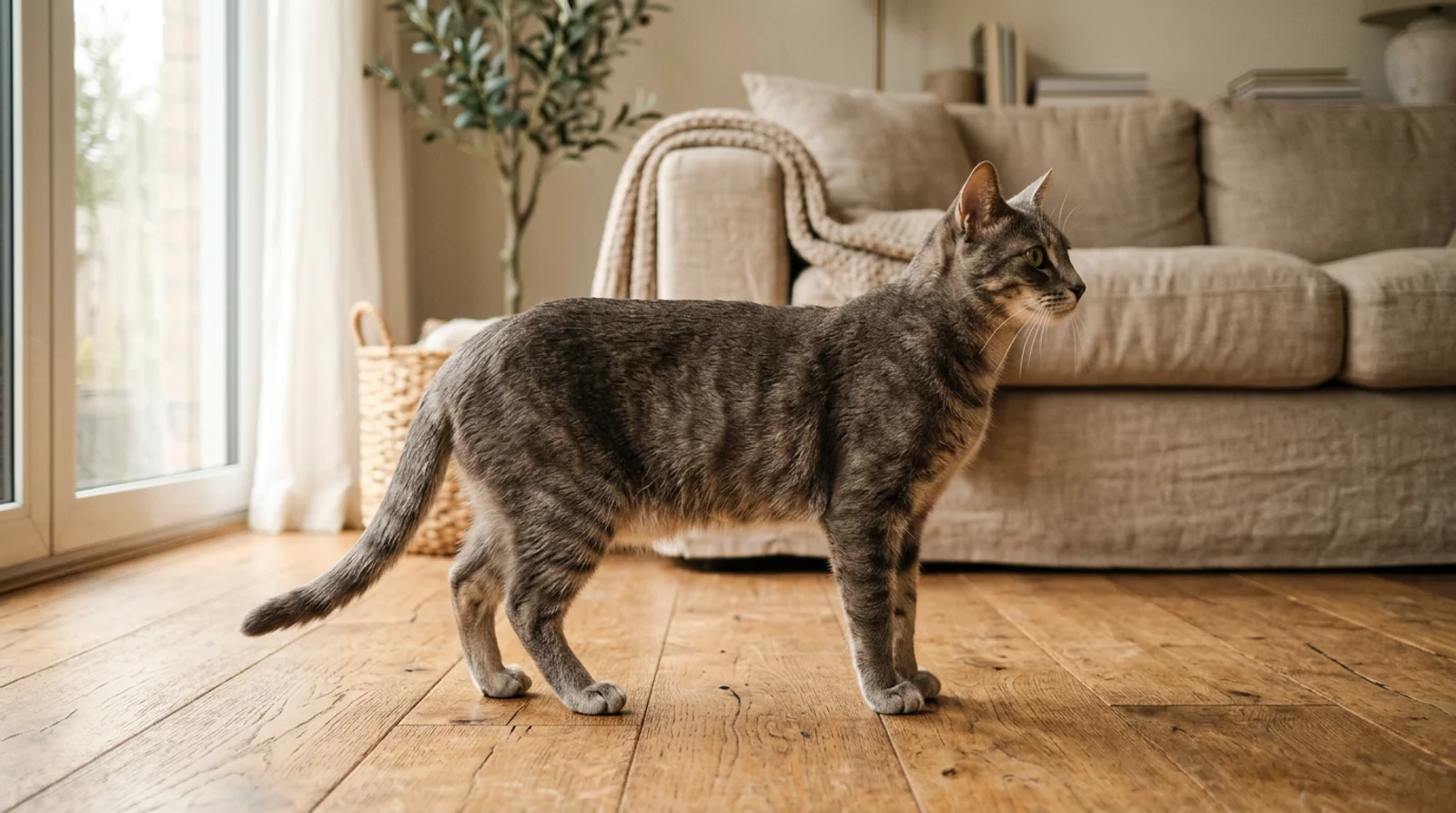
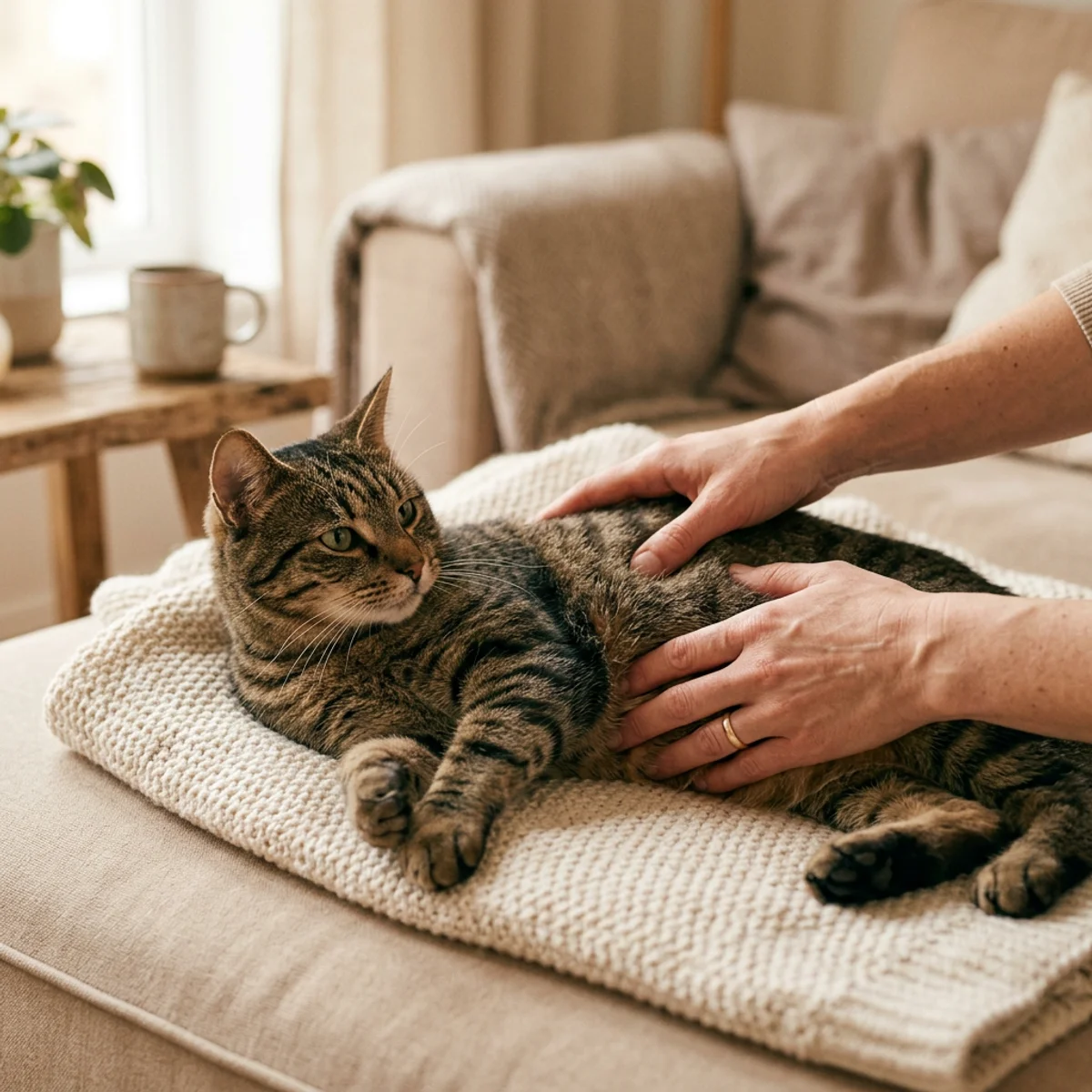
Run your hands along your cat's ribcage. You should feel each rib easily under a thin layer of fat, without pressing hard. Now look from above: a healthy cat has a visible waist—a gentle inward curve between the ribcage and hips. From the side, the belly should tuck up slightly behind the ribs, not hang in a pouch that swings when they walk.
If you can't feel ribs without pressing, if there's no waist, or if a prominent abdominal apron drags, your cat is likely overweight. Veterinarians use a nine-point body condition score; most house cats score a 6 or 7 when they should be a 4 or 5.
When to Weigh
Once you've established a baseline at your vet clinic, weigh your cat every two weeks during active weight loss (many clinics offer free weigh-ins), then monthly for maintenance. We keep a simple baby scale at home; it's accurate to 10 grams and takes the guesswork out of progress.
Overweight Cat Help: Safe and Effective Weight-Loss Strategies
Crash diets are dangerous for cats. Rapid weight loss—more than 1–2% of body weight per week—can trigger hepatic lipidosis, especially in cats who stop eating altogether. The goal is slow, steady reduction: about 40–80 grams per week for an average cat.
Start With Your Veterinarian
Before you cut calories, book a wellness exam. Hypothyroidism, Cushing's disease, and other conditions can mimic or contribute to obesity, and your vet will calculate a target weight and daily calorie budget tailored to your cat's age, activity level, and health status. For example, a 6 kg cat aiming for 4.5 kg might need around 180–200 kcal per day during weight loss.
Choose the Right Food
Weight-loss diets are formulated to be lower in calories but higher in protein and fibre, so your cat feels full and preserves lean muscle. We've had good results with prescription diets like Hill's Metabolic and Royal Canin Satiety, but many high-quality over-the-counter foods work well if you measure portions carefully.
Avoid grain-free or high-fat foods during weight loss; they pack more calories into every bite, making portion control harder. And never free-feed a cat who needs to lose weight. Measured meals are non-negotiable.
Cat Portion Control: Measuring, Timing, and Treats
Eyeballing portions is where most well-intentioned plans fail. A heaping scoop can easily deliver 30% more calories than you think.
The Mechanics of Measuring
- Use a digital kitchen scale (in grams) or a proper measuring cup—not a coffee mug.
- Divide the daily ration into at least two meals, ideally three or four. Smaller, frequent meals help manage hunger and keep metabolism steady.
- Record everything. We use a whiteboard on the fridge: date, weight of food, any treats. It sounds tedious, but it's the fastest way to spot portion creep.
The Treat Problem
Treats are often 10–15 kcal each. Five treats a day can represent 20% of a weight-loss calorie budget—enough to stall progress entirely. Budget for treats within the daily total (no more than 10% of calories), or switch to low-calorie options: a few kibbles of their regular food, freeze-dried chicken breast, or a lick of plain puréed pumpkin.
One of our team members replaced treat-begging with play-begging by tossing a sparkle ball every time her cat meowed at the cupboard. Within a week, the cat started bringing her toys instead of sitting by the treat jar.
Multiple-Cat Households
Feeding cats separately is essential if one needs to lose weight and the other doesn't. Microchip feeders (like the SureFlap) open only for the registered cat, letting you control portions without constant supervision. Alternatively, feed the diet cat in a room behind a closed door for fifteen minutes, then pick up any leftovers.
Cat Exercise and Play: Moving More Without a Treadmill
Cats are sprinters, not marathon runners. You won't see your cat jogging laps, but short bursts of high-intensity play—hunting behaviour—burn calories and build muscle.
Daily Play Sessions
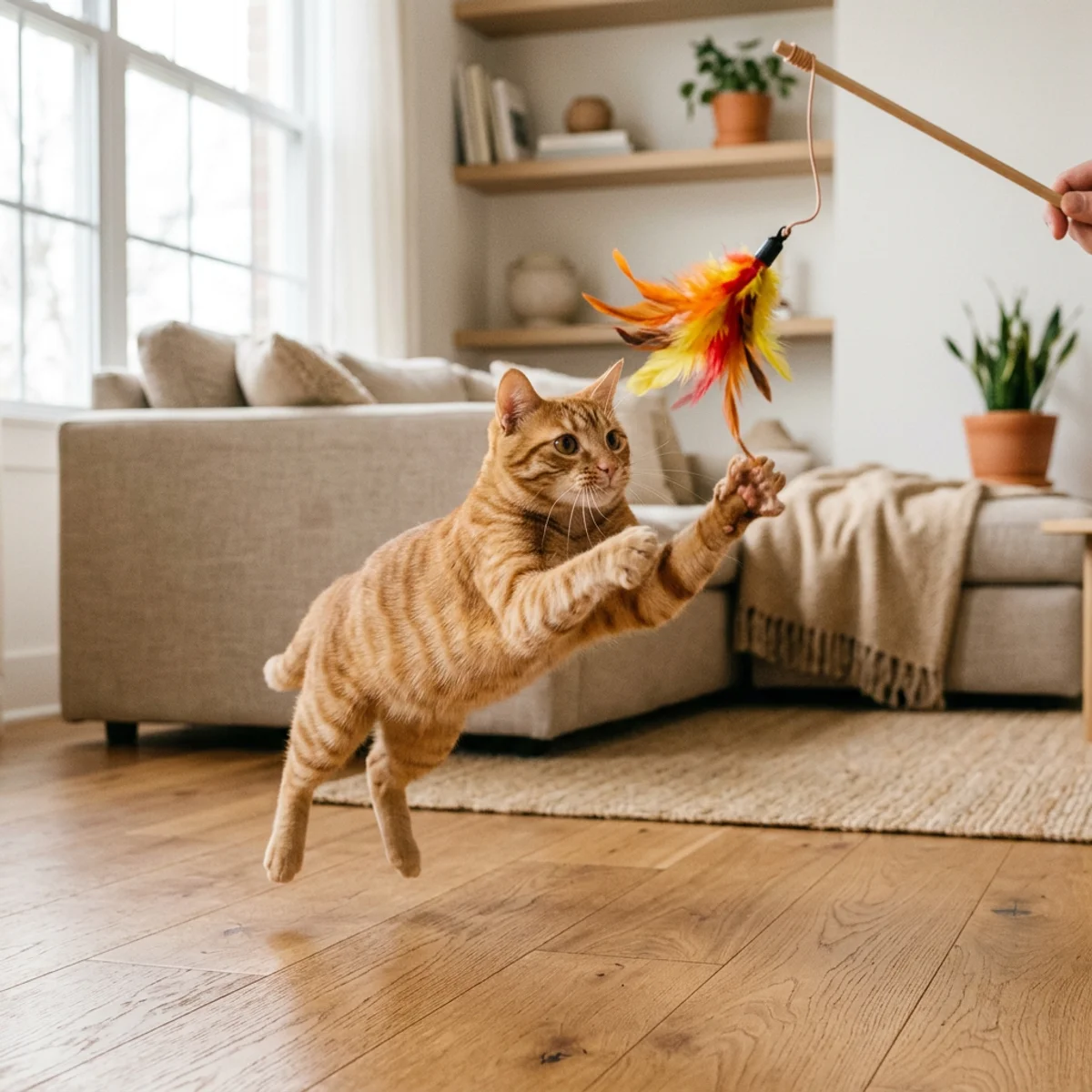
Aim for two or three five-to-ten-minute play sessions every day. Use wand toys (feather teasers, ribbon dancers, fishing-pole toys) to mimic prey: flutter, dart, hide behind furniture, let your cat stalk and pounce. The key is you controlling the toy; battery-operated mice rarely hold a cat's attention for long.
Rotate toys every few days so novelty stays high. We keep a basket of six or seven wand toys and swap them out weekly.
Environmental Enrichment and Vertical Space
Cats who are bored eat for entertainment. Enrichment reduces stress (which we cover in depth in our article on cat stress signs and solutions) and encourages natural movement.
- Vertical territory: Cat trees, wall-mounted shelves, and window perches invite climbing and jumping. Even a modest 1.5-metre tree gives your cat reason to move up and down a dozen times a day.
- Food puzzles: Slow feeders, puzzle balls, and foraging mats turn mealtime into a hunt. Start simple—an egg carton with kibble in each cup—then progress to rolling treat balls or more complex puzzles. This taps into predatory instinct and slows eating, which improves satiety. For more ideas, see our guide to indoor cat enrichment.
- Cardboard boxes and tunnels: Free, endlessly entertaining, and they encourage stalking and pouncing.
Leash Walking
Some cats adapt beautifully to harness training and enjoy supervised outdoor time or even leashed walks. It's not for every cat, but if yours is curious and bold, it's worth trying. Start indoors with a well-fitted H-style harness and let them wear it for short periods before attaching a leash.
Cat Healthy Weight: What Maintenance Looks Like
Once your cat reaches their target weight, the work isn't over—maintenance requires just as much diligence as loss.
Increase calories gradually (by about 10% every week) until weight stabilizes. Continue weighing monthly and measuring portions. Many cats will regain weight if you return to free-feeding, so stick with scheduled meals.
Keep up play and enrichment. Physical activity and mental stimulation are part of a healthy weight, not just a weight-loss tool.
Age and Metabolism
Metabolism slows as cats age. A ten-year-old cat may need 10–15% fewer calories than they did at three, even at the same activity level. Monitor body condition annually and adjust portions as needed. Our article on caring for older pets touches on some of these shifts, though it focuses on dogs—principles of monitoring and adjustment apply across species.
Common Pitfalls We See (and How to Avoid Them)
Giving in to begging. Cats are master manipulators. They will yowl, paw, and stare. Ignore it, redirect with play, or offer a low-calorie distraction like a puzzle feeder with their measured kibble inside.
Inconsistent measuring. One person scoops carefully, another free-pours. Get everyone in the household on the same page: show them the measuring cup, explain the plan, post the feeding schedule.
Stopping too soon. Weight loss is slow. A cat losing 50 grams a week will take three months to lose 600 grams. Celebrate small wins and trust the process.
Skipping vet check-ins. If weight loss stalls for more than three weeks despite compliance, something else may be going on—discuss with your veterinarian before cutting calories further.
FAQ
How long does it take for a cat to lose weight safely?
Plan on 6–12 months for most cats. A 5.5 kg cat aiming for 4.5 kg, losing 50 grams per week, will take about twenty weeks. Slower is safer—rushing risks hepatic lipidosis.
Can I use a regular adult cat food, or does my cat need a special weight-loss diet?
You can use regular food if you measure portions strictly and the food is high in protein and moderate in fat. Weight-management formulas simply make it easier by providing more volume and satiety per calorie. If your cat seems constantly ravenous on regular food, consider switching.
My cat won't play—what now?
Some cats need retraining. Start with very short sessions (two minutes) and experiment with different toy types: some cats ignore feathers but go wild for crinkle balls or laser pointers (always end a laser session by letting them "catch" a physical toy or treat). Try playing right before a meal when prey drive is highest. If your cat truly won't engage, focus on environmental enrichment and portion control—weight loss is still possible without vigorous play.
Is it okay if my cat has a primordial pouch?
Yes. The primordial pouch is a loose flap of skin and tissue along the belly, most visible in breeds like Bengals and Egyptian Maus but present in many cats. It's not fat—it's an evolutionary feature that protects internal organs and allows greater stretch when running and jumping. You can feel the difference: a pouch is loose skin with minimal fat; an overweight belly is firm and round with fat you can pinch.
A Few Final Thoughts
We know how hard it is to ignore those green eyes at dinnertime, or to switch from an overflowing bowl to a measured quarter-cup. But every gram your cat loses buys them more comfortable years: easier grooming, less joint pain, better glucose control, more confident jumps.
Weight management is one of the most powerful things you can do for your cat's longevity, and it doesn't require expensive equipment or complicated protocols—just consistency, patience, and a good kitchen scale. If you're feeling stuck, reach out to your veterinary team; many clinics offer free weight-management coaching and check-ins.
And if you're ready to make mealtime part of the enrichment plan, explore our curated selection of feeding stations and slow-feeder bowls designed to turn every meal into a small, satisfying hunt.