Best Cat Trees for Small Spaces: Compact & Stylish Options
Best Cat Trees for Small Spaces: Compact & Stylish Options
Your cat needs to climb, scratch, and lord over her territory from on high—but your 600-square-foot apartment has exactly zero spare metres of floor space. We get it. Living in a small Toronto condo with two Bengals taught us that cat trees for small spaces aren't about compromise; they're about strategy. The right compact design delivers full vertical enrichment while claiming less than half a square metre of floor—or none at all if you mount it to the wall.
Why Vertical Space Matters More in Small Apartments
Cats are hardwired to climb. In the wild, vertical territory means safety from predators, hunting advantage, and a stress-relief outlet when things get tense. Your 4-kilogram tabby doesn't care that you're renting a studio in Vancouver—she still needs height.
Traditional cat trees sprawl across 90 × 90 cm of prime real estate. In a small apartment, that footprint is brutal. Compact cat trees build up instead of out: slim bases, tall sisal posts, tiered platforms. Your cat gets the vertical range she craves without turning your entryway into an obstacle course.
We've also noticed cats in smaller homes show more stress behaviours—fewer escape routes, overlapping territories, no place to retreat when the doorbell rings. A well-placed cat tree creates a dedicated safe zone where your cat can nap above the fray and feel secure. If your cat is already showing tension, our guide to cat stress signs and solutions offers more strategies.
Compact Cat Trees: Maximum Height, Minimum Footprint
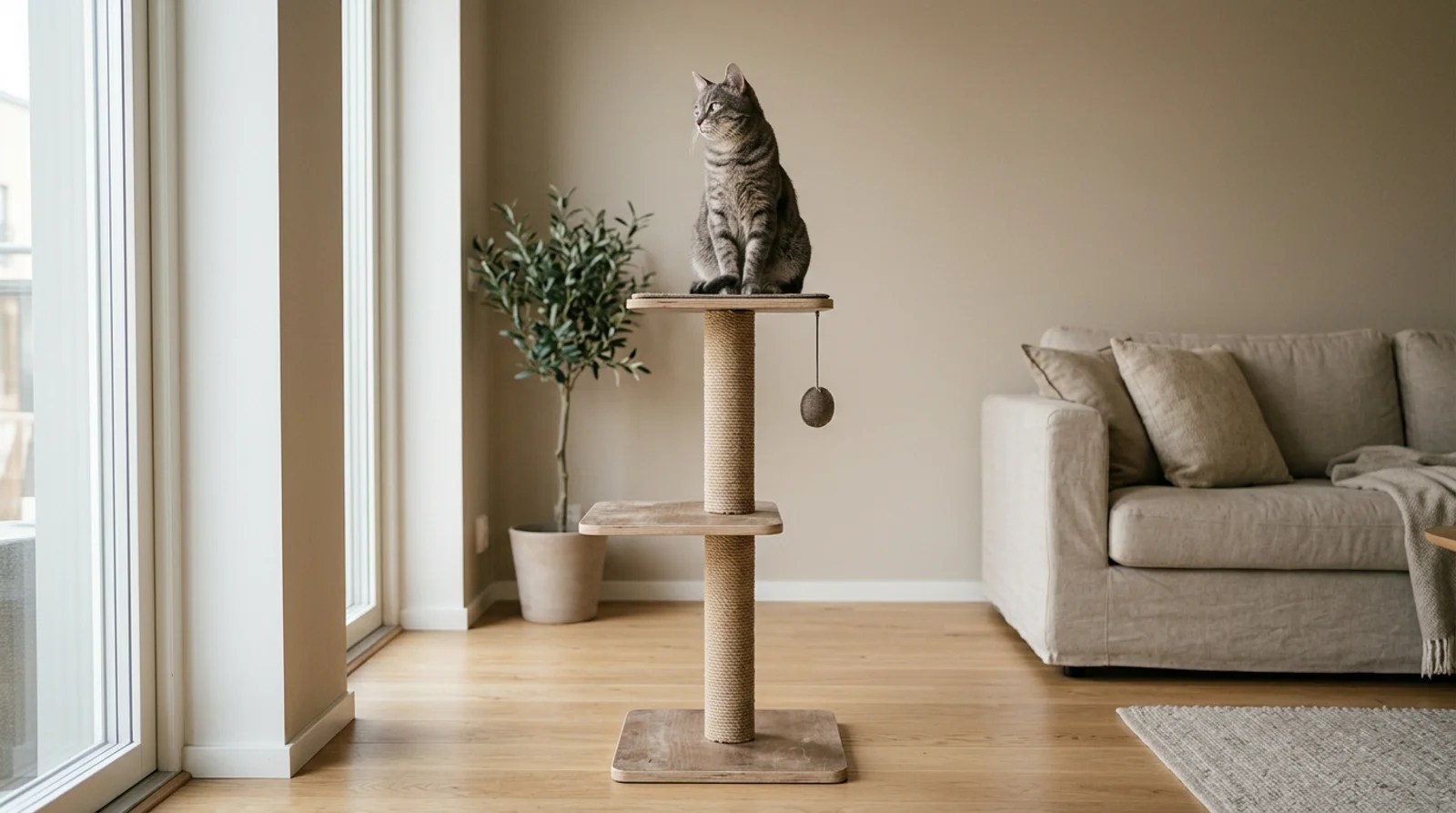
A truly compact cat tree occupies 40 × 40 cm to 50 × 50 cm of floor space but stretches 120 to 180 cm tall. These designs are made for corners, the gap beside your sofa, or that awkward space next to the bookshelf.
Look for a single central post wrapped in sisal—essential for scratching—and two or three staggered platforms. The best compact trees include at least one enclosed hideaway near the base. Cats feel safest when they can duck into a cave-like space, especially in busy households. The top perch should be wide enough for a full stretch: minimum 35 cm diameter. Anything smaller and your cat will drape off the edge like a disgruntled gargoyle.
We strongly prefer neutral tones: grey, beige, soft taupe. Brightly coloured plush screams "pet store clearance" and clashes with nearly everything. A well-designed compact tree should blend into your décor like a piece of furniture, not announce itself from across the room.
What to prioritize:
- Stability over size. A narrow base plus a tall post can topple if the platform isn't weighted or anchored. Check the product weight—heavier is almost always safer.
- Sisal-wrapped posts. Carpet-covered posts wear out fast and don't satisfy a cat's need to really dig her claws in. For more on scratching behaviour, see our cat scratching post buying guide.
- Raised hideaway. Cats in small spaces need vertical privacy, not just floor-level dens. A mid-height cave gives them an escape hatch without sacrificing the top perch.
One honest caveat: compact trees work beautifully for one or two average-sized cats under 5 kg each. If you share your apartment with a 7-kilogram Maine Coon or three rambunctious shorthairs, you'll need a more robust solution—or multiple trees.
Wall-Mounted Cat Trees: Zero Floor Footprint
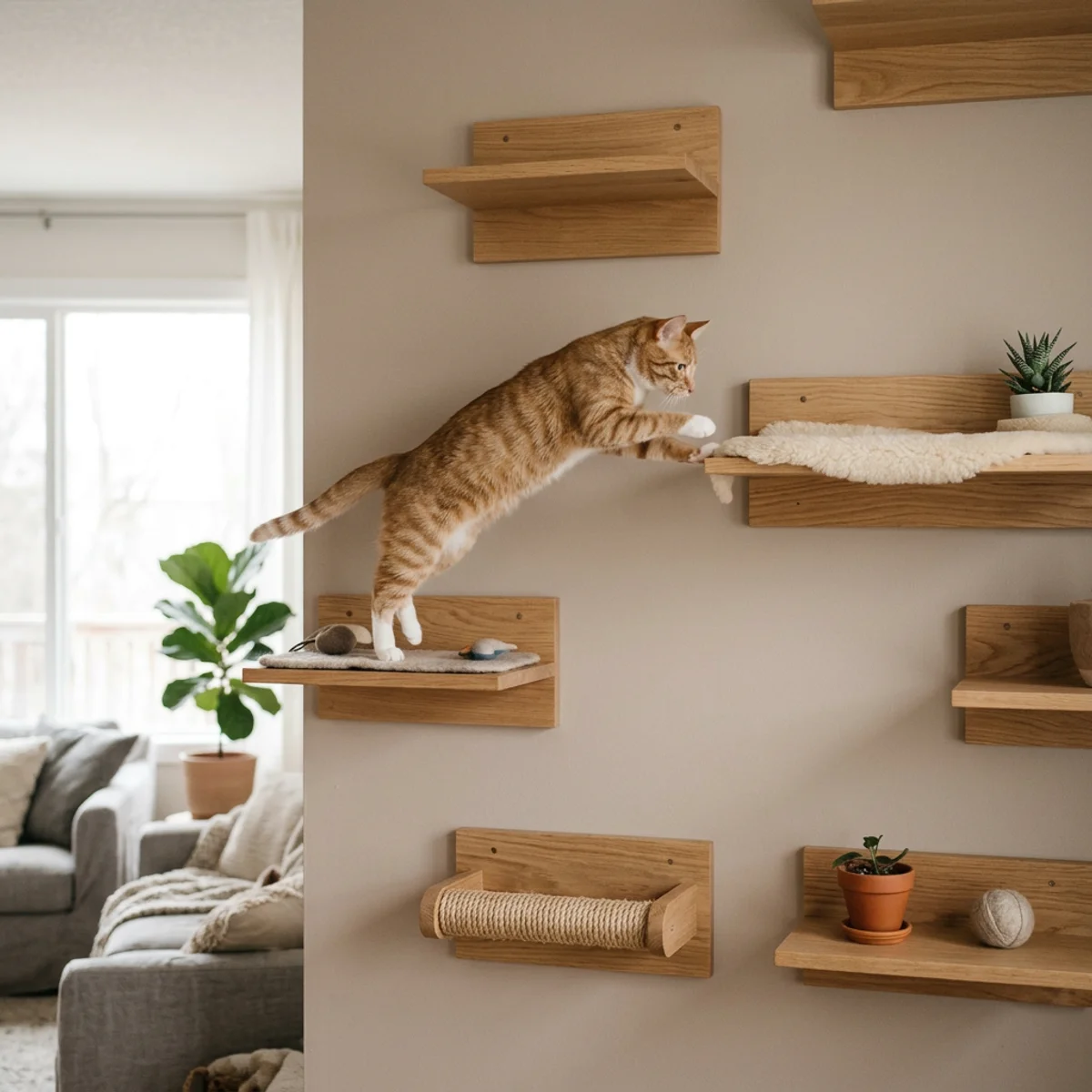
Wall-mounted cat furniture is the ultimate space saver. Zero floor footprint, infinite configurability, and—if you choose a clean, modern design—it doubles as sculptural wall art.
A wall-mounted cat tree consists of individual shelves, perches, and ramps mounted at staggered heights. Cats leap from level to level, turning a blank wall into a vertical jungle gym. We've installed sets in our own homes (and helped friends do the same), and the transformation is immediate: cats spend hours patrolling their new aerial highway, often ignoring their old floor-bound furniture entirely.
Installation tips from experience:
- Find the studs. Drywall anchors are not enough for a 5-kilogram cat launching herself onto a floating perch. Use a stud finder and mount brackets directly into studs. This is non-negotiable.
- Stagger heights by 30–45 cm. Cats can jump much higher, but closer spacing feels more secure and encourages use by older or less athletic cats.
- Include at least one resting platform. Not every element needs to be a narrow perch. A 40 × 30 cm padded shelf gives your cat somewhere to lounge, not just land.
- Add a sisal scratch pad or post. Wall systems often omit scratching surfaces. Mount a small sisal board or corner scratcher nearby so your cat can complete the full climb-scratch-nap cycle.
Wall-mounted setups work exceptionally well in rental apartments if you're willing to patch a few screw holes when you move. We are—it's worth it. If that's a dealbreaker, consider freestanding ladder-style cat trees that lean against a wall and require no drilling.
For more ideas on integrating pet furniture into your décor without sacrificing style, explore our small-space solutions for pet owners.
Corner and Floor-to-Ceiling Designs for Small Apartments
Corners are wasted space in most apartments. A corner cat tree claims that real estate brilliantly. These designs tuck into a 90-degree angle with a triangular or wedge-shaped base, leaving the centre of your room clear.
Corner trees often rise 150 to 200 cm tall, with platforms arranged in a spiral or zigzag. The vertical climb keeps cats engaged—they'll race up and down, especially during evening zoomies. We've also found that corner trees give shy cats a sense of enclosure on two sides, which many prefer over an exposed, freestanding post in the middle of a room.
Features that make a corner tree worth it:
- Multi-level platforms. At least three, ideally four, so multiple cats can coexist without conflict.
- A top perch at or near ceiling height. Cats want the highest point. A 180-cm tree in a room with 240-cm ceilings leaves a frustrating gap for a climber.
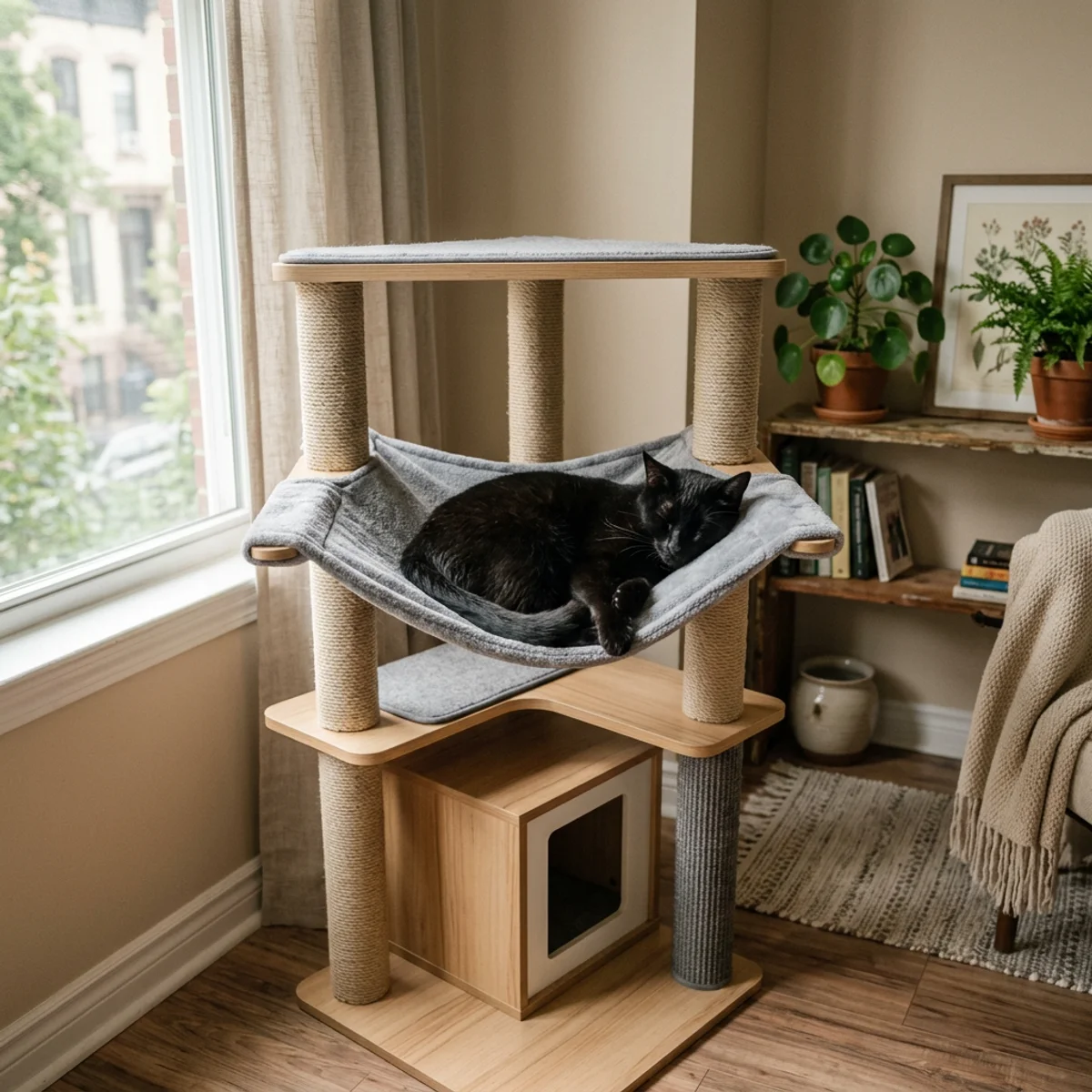
- Integrated hammock or basket. These cradle a cat's body and save space compared to a full rectangular platform.
Vertical cat trees—freestanding poles that reach floor to ceiling with tension mounts—are another smart small apartment cat tree option. They look like modern sculptures, occupy about 30 × 30 cm of floor, and hold multiple perches. The tension mechanism means no drilling, and you can reposition the tree if you rearrange furniture.
One downside: tension trees rely on your ceiling height being within a specific range, usually 230–270 cm. Measure carefully before buying.
Space-Saving Cat Furniture Beyond the Tree
Not every cat needs a full tree. Some are perfectly content with a combination of space-saving pieces that together offer climbing, scratching, and lounging.
We've pieced together setups using:
- A tall scratching post (90–120 cm) with a single top platform. Takes up the space of a floor lamp. Pair it with a wall-mounted shelf above and you've created a two-level climb.
- A window perch with suction mounts or bracket support. Cats spend hours at windows. A sturdy perch there does double duty as enrichment and furniture. For more on keeping indoor cats engaged, see indoor cat enrichment ideas.
- Modular cat cubes. Stackable felt or wood cubes that function as hideaways and can be rearranged as your space (or your cat's preferences) change.
This à la carte approach works especially well if you're still figuring out where your cat likes to spend time. Invest in one anchor piece—a tall post or a corner perch—then add elements as needed.
What to Avoid When Choosing a Cat Tree for a Small Space
We've made enough mistakes (and seen enough wobbly, unused trees in friends' apartments) to know what doesn't work.
Skip these:
- Flimsy materials. Particleboard that bows under 4 kilograms is a waste of money. Look for solid wood posts or heavy-duty engineered wood with good reviews mentioning stability.
- Too many dangly toys. A hanging pom-pom or two is fine. Five fuzzy balls on elastic strings look chaotic and collect dust. Most cats ignore them after the first day anyway.
- Carpet that sheds or smells. Cheap plush gives off a chemical odour and leaves fuzz all over your clothes. If the product photos show very fuzzy, brightly dyed finishes, assume it will shed.
- Platforms too small for your cat. Measure your cat while she's stretched out in a full side-lying position. Add 10 cm. That's the minimum platform length.
Also, resist the urge to buy a tree that's far too short. A 60-cm "cat tree" is really a scratching post with delusions of grandeur. Cats want height. Anything under 100 cm won't satisfy a climber.
FAQ
What's the smallest footprint for a functional cat tree?
About 40 × 40 cm. Any smaller and the base won't be stable enough for a cat to launch from the top platform. Wall-mounted systems have zero floor footprint and are the ultimate space saver, but they require drilling into studs.
Do cats actually use wall-mounted cat furniture?
Yes—enthusiastically, in our experience. Cats are natural climbers and will take any route you offer. Wall shelves often get more use than traditional trees because they let cats patrol the perimeter of a room, which aligns with their territorial instincts. The key is spacing the elements close enough that even a cautious cat feels confident jumping.
Can I put a cat tree in a bedroom or hallway?
Absolutely. A slim cat tree in a bedroom corner gives your cat a retreat that's quiet and away from household traffic—ideal for anxious cats. Hallways work if the tree's footprint is narrow enough to leave a clear walkway (at least 60 cm). Just make sure the tree won't get knocked every time someone walks past; stability is critical.
How do I keep a tall cat tree from tipping over?
Choose a model with a wide, heavy base—at least 5 to 7 kilograms for a tree over 150 cm. Some compact trees include wall anchors (a bracket that screws into the wall near the top of the tree). Use them, especially if you have a large or energetic cat. Tension-mounted floor-to-ceiling trees are inherently stable because they brace against the ceiling.
Bringing It All Together
A small apartment doesn't mean your cat has to live at ground level. The best cat trees for small spaces prioritize vertical real estate, stable construction, and clean design that fits your home, not just your cat's needs. Whether you choose a compact corner tree, a wall-mounted system, or a single tall post with a premium perch, you're giving your cat the enrichment she needs while keeping your floor space open.
We've curated a selection of compact, modern cat furniture that works hard in small homes—browse our collection and find something that makes both you and your cat happy.