How to Choose the Best Cat Scratching Post for Your Home
How to Choose the Best Cat Scratching Post for Your Home
The best cat scratching post is tall enough for your cat to stretch fully (at least 80 cm), stable enough that it won't wobble under vigorous scratching, wrapped in sisal rope or fabric, and—honestly—something you don't hate looking at every day. That last criterion matters more than most buying guides admit, because a scratcher shoved into the basement won't save your sofa.
We've tested dozens of scratchers with our own cats (including a particularly destructive Bengal mix and a 6 kg senior tabby who thinks the dining-room chairs are her personal manicure station). What we've learned: the "right" post depends as much on your cat's scratching style and your home's layout as it does on any single feature. A squat cardboard pad works beautifully for some cats and gets ignored by others. A towering sisal post might anchor your living room or look ridiculous next to your mid-century credenza.
This cat scratching post guide walks through the decisions that actually matter—height, stability, material, and yes, aesthetics—so you can choose a scratcher your cat will use and you'll be happy to live with.
Why Scratching Posts Matter (Beyond Furniture Protection)
Cats scratch to shed the outer sheath of their claws, mark territory through scent glands in their paws, and stretch their shoulder and back muscles. It's not optional behaviour, and it's not spite when your cat shreds the arm of your favourite chair. It's biology.
Providing an appropriate outlet doesn't just protect your furniture—it satisfies a core need. Cats who don't have access to good scratching surfaces often develop stress behaviours or redirect their energy into less desirable habits. We've seen cats who were labelled "destructive" transform completely once they had a tall, sturdy post in the right location.
The key phrase there is "right location." A scratching post tucked away in a spare bedroom is decoratively tidy and behaviourally useless. Cats scratch when they wake up, when they're excited, and when they want to mark high-traffic areas. Your scratcher needs to live where your cat actually spends time—often near their favourite napping spot or by the entrance to a room. If you're dealing with an active furniture scratcher, check out our guide on how to stop cat scratching furniture for placement strategies and deterrent tips.
A Tall Cat Scratching Post Is Almost Always Better
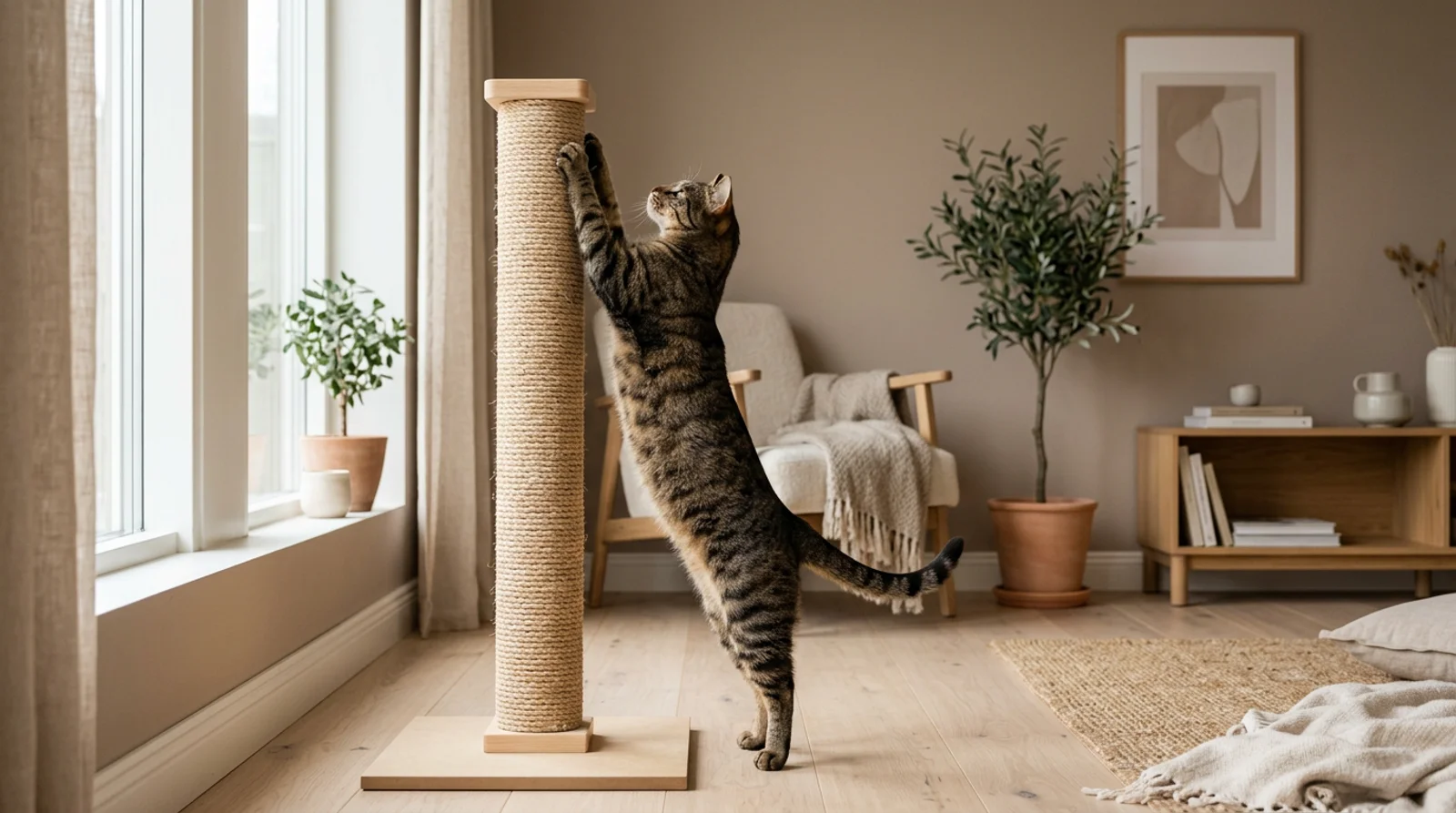
A tall cat scratching post lets your cat stretch to full extension, which is the whole point. Measure from your cat's nose to the tip of their tail when they're standing; add 10–15 cm. For most cats, that means a minimum of 80 cm, and many cats—especially long-bodied breeds like Bengals, Maine Coons, or even rangy domestic shorthairs—prefer 90–100 cm or more.
Short posts (under 60 cm) are common in big-box stores and almost universally disappointing. Your cat will either ignore them or use them in a crouch, which defeats the stretching function. We've bought plenty of these over the years, lured by low prices, and every one ended up as a very expensive donate-pile item.
Why Vertical Matters More Than You'd Think
Cats who scratch vertically (as opposed to horizontally on the floor) are stretching their entire spine and shoulder girdle. A post that's too short forces them to hunch, which feels unsatisfying and makes the post less appealing than, say, the corner of your sofa, which offers full height.
If you have a kitten, buy for the adult size now. Kittens grow fast, and replacing a post every few months is expensive and teaches your cat that scratching surfaces are temporary. A 90 cm post will serve a kitten just fine and grow with them.
Stability: The Non-Negotiable Feature
A wobbly post is a useless post. Cats put real force into scratching—especially when they're stretching and pulling downward—and if the post tips or rocks, they'll abandon it immediately. Once a cat decides a scratcher is unstable, it's nearly impossible to rebuild their trust in it.
Look for a heavy, wide base (at least 40 × 40 cm for a freestanding post) or a design that anchors to a wall or ceiling. Particle-board bases covered in carpet are common and often adequate for cats under 5 kg, but larger or more athletic cats need something heftier—solid wood or weighted platforms.
We've had good results with posts that have a rectangular base rather than a round one; they're harder to tip. Some modern designs use a tripod-style base, which looks sleek and works well as long as the footprint is wide enough.
Testing Stability Before You Buy (or Assemble)
If you're shopping in person, push hard on the top of the post at an angle. It should resist. If you're buying online, check the base dimensions and weight in the specs. A post that weighs less than 4 kg is suspect unless it's designed to be wall-mounted.
Once you've assembled it at home, test it yourself before introducing it to your cat. Press down and pull as if you were scratching. If it wobbles under your hand, your cat will notice immediately.
Scratching Post Materials: Sisal, Carpet, Cardboard, and Wood
The surface material determines whether your cat will actually use the post. Cats have strong preferences, and those preferences are individual—but some patterns hold true across most cats we've lived with and observed.
Sisal Rope and Sisal Fabric
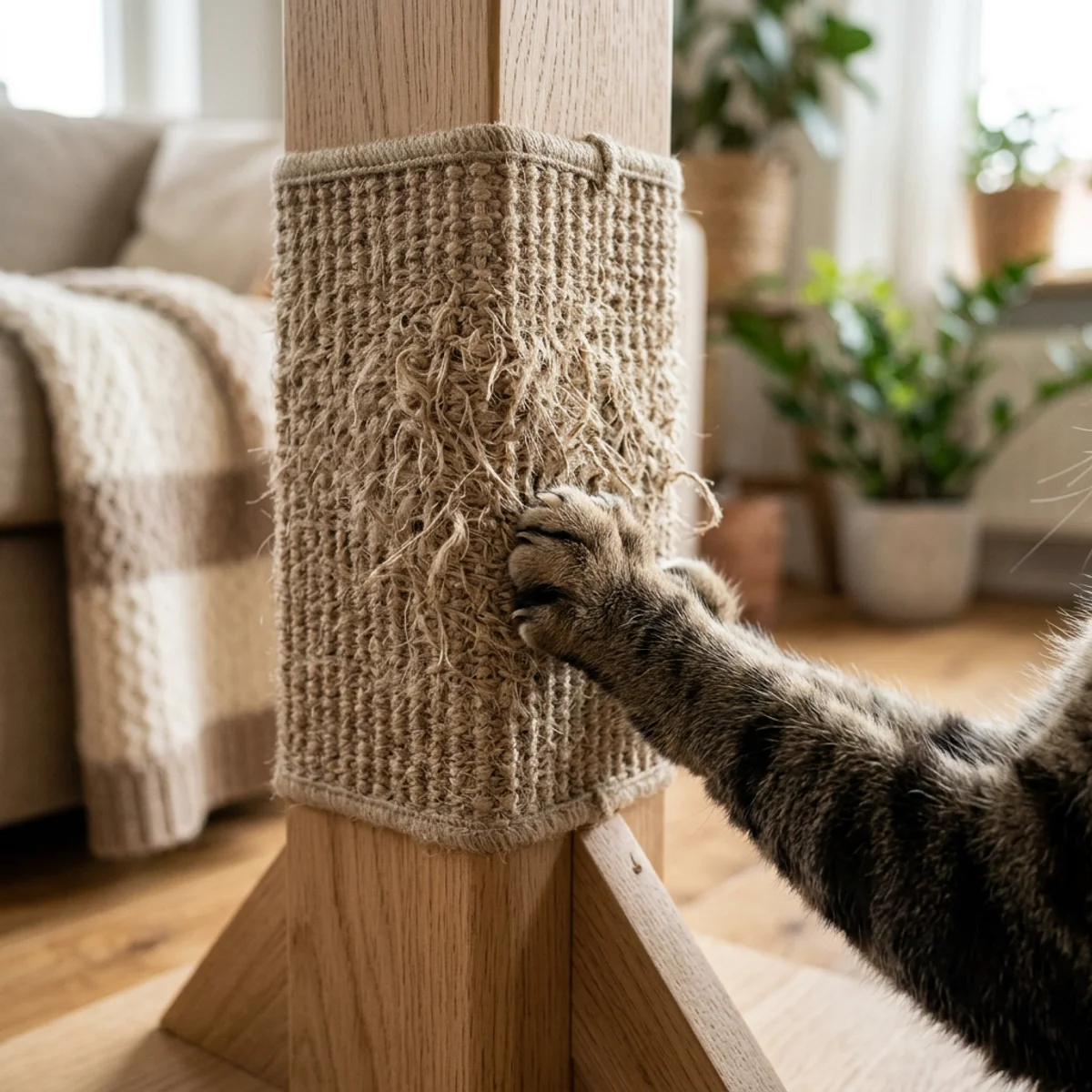
Sisal is the gold standard. It's durable, has a satisfying texture that mimics tree bark, and holds up to thousands of scratches without shredding into a mess. Sisal rope is wrapped around a post in a spiral; sisal fabric is woven and glued or stapled flat onto a surface.
Rope is more common and slightly more durable, but fabric offers a smoother scratch that some cats prefer. Either way, sisal is far superior to carpet. It doesn't snag claws the way looped carpet does, and it lasts years instead of months.
If you're choosing between rope and fabric, go with rope for a vertical post and fabric for horizontal or angled surfaces. Our cats tend to dig into rope with gusto and use fabric for lighter, maintenance scratching.
Carpet-Covered Posts (Proceed with Caution)
Carpet is inexpensive and widely available, which is why so many budget posts are covered in it. But carpet has two problems: it snags claws (uncomfortable for the cat), and it looks and feels similar to your actual carpet and upholstery. You're essentially training your cat that soft, fibrous fabric is an appropriate scratching surface.
We've seen this backfire more than once. A cat happily uses a carpeted post and then generalizes that texture to the living-room rug. If you already own carpet-covered furniture, consider a different material for the post to create a clear distinction.
Cardboard Scratchers
Cardboard is a horizontal or angled scratcher favourite, not a post material. Cats love the texture, it's inexpensive, and it's recyclable. The downside: it's messy (cardboard dust everywhere) and needs replacing every few months.
Cardboard works best as a supplement, not a primary scratcher. Many cats enjoy having both a tall sisal post for stretching and a flat cardboard pad for lounging-and-scratching sessions. If you have space, offer both.
Bare Wood and Other Textures
Some modern cat scratchers use untreated wood, woven seagrass, or cork. These look beautiful and appeal to design-conscious pet parents. Cats' opinions vary. Wood is closest to what cats would scratch in nature (tree bark), but it's hard and doesn't shed a claw sheath as easily as sisal.
If you're drawn to a wood or alternative-material scratcher, make sure it's at least 5 cm thick and has visible grain or texture. Smooth, sealed wood is too slippery for most cats.
Modern Cat Scratcher Designs That Don't Ruin Your Décor
Let's be honest: most cat furniture is hideous. Beige carpet towers festooned with dangling toys and pompoms might thrill a cat (or not), but they make your living room look like a daycare centre.
The good news is that modern cat scratcher design has improved dramatically in the past five years. You can now find tall, functional posts in natural materials—untreated wood bases, natural sisal, neutral linen tones—that look like intentional furniture rather than pet-store overflow.
What "Design-Forward" Actually Means
A modern cat scratcher typically features:
- Neutral colours: warm wood, black, white, grey, natural sisal beige—no cartoon mice or bubblegum pink.
- Clean lines: geometric bases, minimal ornamentation, no attached toys.
- Quality materials: solid wood or powder-coated metal instead of particle board and polyester carpet.
- Multi-function design: some double as side tables, planters, or room dividers.
We've curated pieces that fit seamlessly into contemporary, Scandinavian, mid-century, and minimalist interiors. When a scratcher looks good, you're far more likely to place it where your cat will actually use it—which is the entire point.
For more ideas on integrating pet gear into your home without sacrificing style, see our pet-friendly home décor ideas and small space solutions.
How Many Scratching Posts Do You Need?
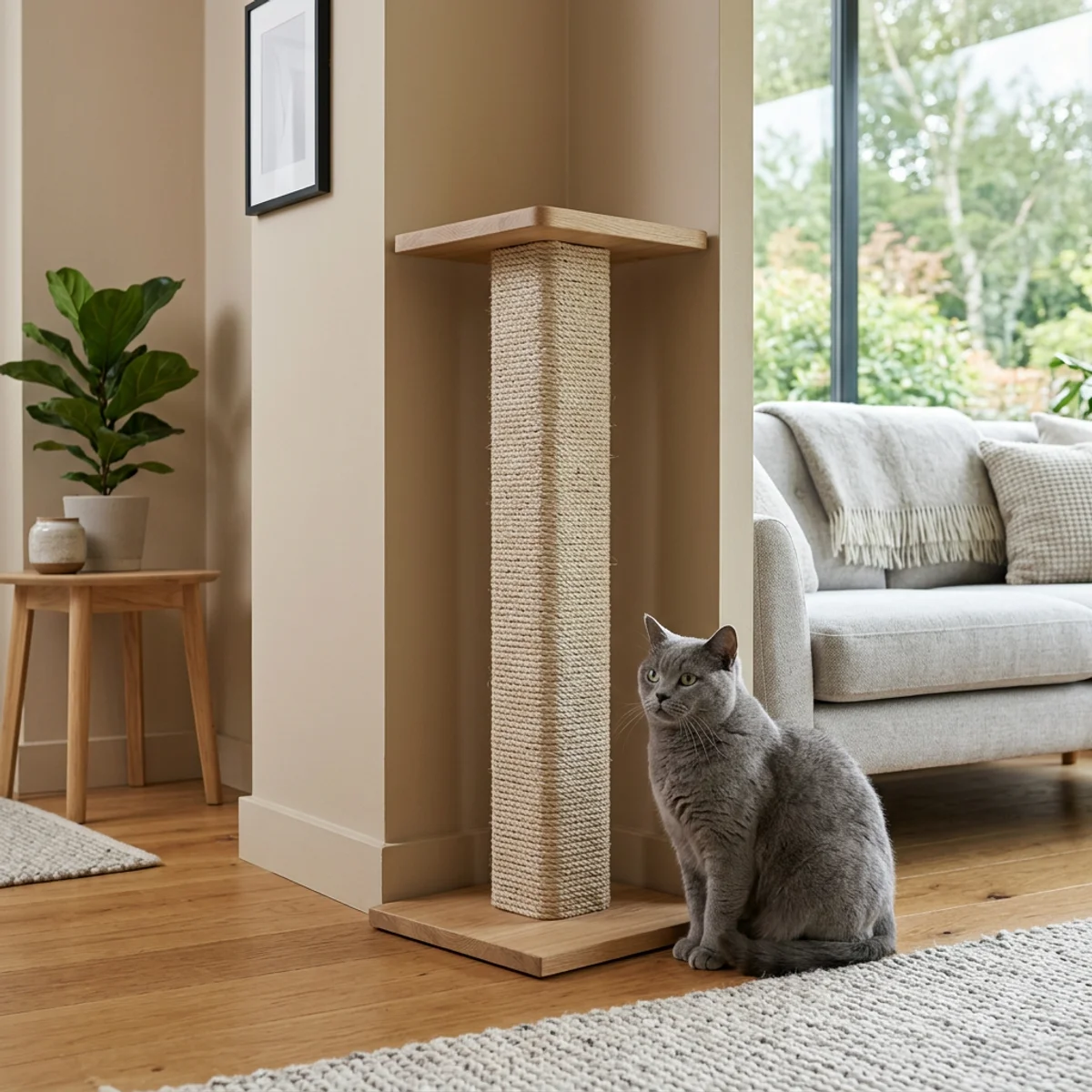
One per cat, minimum, plus one extra if you have the space. Cats are territorial, and sharing a single post can create stress—especially in multi-cat households.
Beyond quantity, think about variety and placement. Offer at least one tall vertical post and one horizontal or angled scratcher. Place scratchers in high-traffic areas: near the cat's favourite sleeping spot, by a sunny window, next to the sofa they're currently shredding.
If you're dealing with a dedicated furniture scratcher, position a post directly in front of the targeted furniture, then gradually move it a few centimetres per day to a more acceptable permanent spot. This works surprisingly well.
Cat Scratching Post Buying Guide: Quick Decision Matrix
| Your Situation | Best Choice | Why |
|---|---|---|
| Large cat (>5 kg) or long-bodied breed | Post ≥90 cm, heavy base (≥5 kg) | Needs full stretch and won't tip it |
| Small apartment, limited floor space | Wall-mounted or corner post | Saves floor space, still offers height |
| Multi-cat household | Multiple posts in different rooms | Reduces territorial stress |
| Modern, minimalist décor | Natural wood base, sisal, neutral tones | Blends instead of clashing |
| Cat ignores vertical posts | Horizontal cardboard or angled sisal pad | Some cats prefer scratching flat |
| Budget-conscious | Tall sisal-rope post, simple design | Functionality over features; skip carpet |
What Not to Waste Money On
Skip scratching posts with:
- Attached condos or platforms unless your cat genuinely uses vertical space. Most "cat trees" are under-tall posts with wobbly platforms glued on. If you want vertical territory, buy a dedicated cat tree; if you want a scratcher, buy a scratcher.
- Dangling toys. They break, tangle, and your cat stops caring about them in a week.
- Carpet covering, unless you've confirmed your cat loves carpet and you're okay with the potential spillover to your actual carpet.
- Short posts (under 70 cm). These are shelf filler, not functional gear.
Introducing a New Scratching Post
Place it where your cat already scratches or where they wake up from naps. Sprinkle a pinch of catnip on the base if your cat responds to it (about 70% of cats do; it's genetic). Gently take your cat's paws and mimic a scratching motion on the post—some cats get the idea immediately.
Don't punish your cat for scratching the wrong thing; redirect them to the post and reward them with praise, treats, or play when they use it. Consistency and placement matter more than any training trick.
If your cat continues to ignore the post after a week, reassess the location and material. Cats are honest critics. An ignored post is telling you something—usually that it's in the wrong spot, too short, or the wrong texture. For more strategies, our article on cat stress signs and solutions covers how environmental changes (including scratching options) affect feline behaviour.
FAQ
How tall should a cat scratching post be?
At least 80 cm, and ideally 90–100 cm for most adult cats. Your cat should be able to stretch fully upward with front legs extended without running out of post. Measure your cat from nose to tail tip while standing and add 10 cm as a guideline.
What is the best material for a cat scratching post?
Sisal rope or sisal fabric. Both are durable, satisfying to scratch, and don't snag claws the way carpet does. Cardboard is excellent for horizontal scratchers but needs frequent replacement. Avoid carpet if possible—it wears out quickly and can teach cats that soft fabric is fair game.
Why does my cat ignore the scratching post?
Usually because it's too short, unstable, in the wrong location, or covered in a texture your cat doesn't like. Cats scratch where they sleep, eat, and play—not in a basement corner. Move the post to a high-traffic area, ensure it doesn't wobble, and confirm it's tall enough for a full stretch. If the material is carpet, try sisal instead.
Can I train an older cat to use a scratching post?
Yes. Place the post directly in front of the furniture or surface they currently scratch. Reward them with treats or play every time they use the post. You can also rub a bit of catnip into the sisal or use a pheromone spray designed to attract cats. Patience and placement are more important than the cat's age. Older cats are just as capable of learning new habits—they simply need the right motivation and setup.
Choosing a Scratcher Your Cat Will Love (and You Won't Hide)
The best cat scratching post is the one your cat uses every day and that you're willing to put in the middle of your living room. Those two criteria are inseparable. A beautiful post that lives in a closet won't save your furniture, and an ugly post that you banish to the basement won't either.
Invest in height, stability, and sisal. Skip the carpet, the toys, and the too-short "kitten" posts. Place it where your cat actually spends time, and give them a week to discover it. Most cats, given a proper option, will choose the post over your sofa.
We've built our collection around scratchers that meet both needs—feline function and human aesthetics—because we believe you shouldn't have to compromise. Browse our curated scratching posts to find one that works as hard as it looks good.