How to Choose the Right Cat Litter Box: Size, Type & Placement
How to Choose the Right Cat Litter Box: Size, Type & Placement
Last month, one of our team members switched her 6 kg tabby from a standard covered box to a large, open pan. Three years of inconsistent litter-box behaviour vanished in four days. The box itself was the problem—too small, too enclosed, too tucked into a dark basement corner. We see this constantly: owners assume any box will do, then spend months troubleshooting accidents that stem from a setup the cat simply won't tolerate.
Learning how to choose cat litter box that actually suits your cat (not just your décor) solves more behaviour issues than any amount of expensive litter or supplements. The right size, style, and location make the difference between a cat who uses the box reliably and one who starts avoiding it.
Cat Litter Box Size: Bigger Really Is Better
The single most common mistake? Buying a box that's too small. Cats need room to turn around, dig, and cover waste without their hindquarters hanging over the edge or their head hitting a lid.
The baseline rule: your litter box should be at least 1.5 times your cat's length from nose to base of tail. For an average 4–5 kg domestic shorthair (roughly 45 cm long), that means a box at least 65–70 cm long. If you live with a Maine Coon, a Ragdoll, or any cat over 6 kg, you're looking at 75–90 cm or larger.
We've tested dozens of boxes in our own homes. Here's what we've learned:
- Kittens grow fast. That 25 cm starter box will be outgrown in three months. Buy the adult size from the start and save yourself a second purchase.
- Overweight or senior cats need even more space to manoeuvre comfortably. A 7 kg cat with arthritis won't crouch in a cramped box—she'll find your bath mat instead.
- High sides (15–20 cm) contain litter scatter but can deter older cats or kittens. Look for a box with one lower entry side if mobility is a concern.
Most "large" boxes sold in big-box pet stores are still barely adequate. If you're ordering online, check the interior dimensions in centimetres—not the marketing copy.
Covered vs Open Litter Box: What Cats Actually Prefer
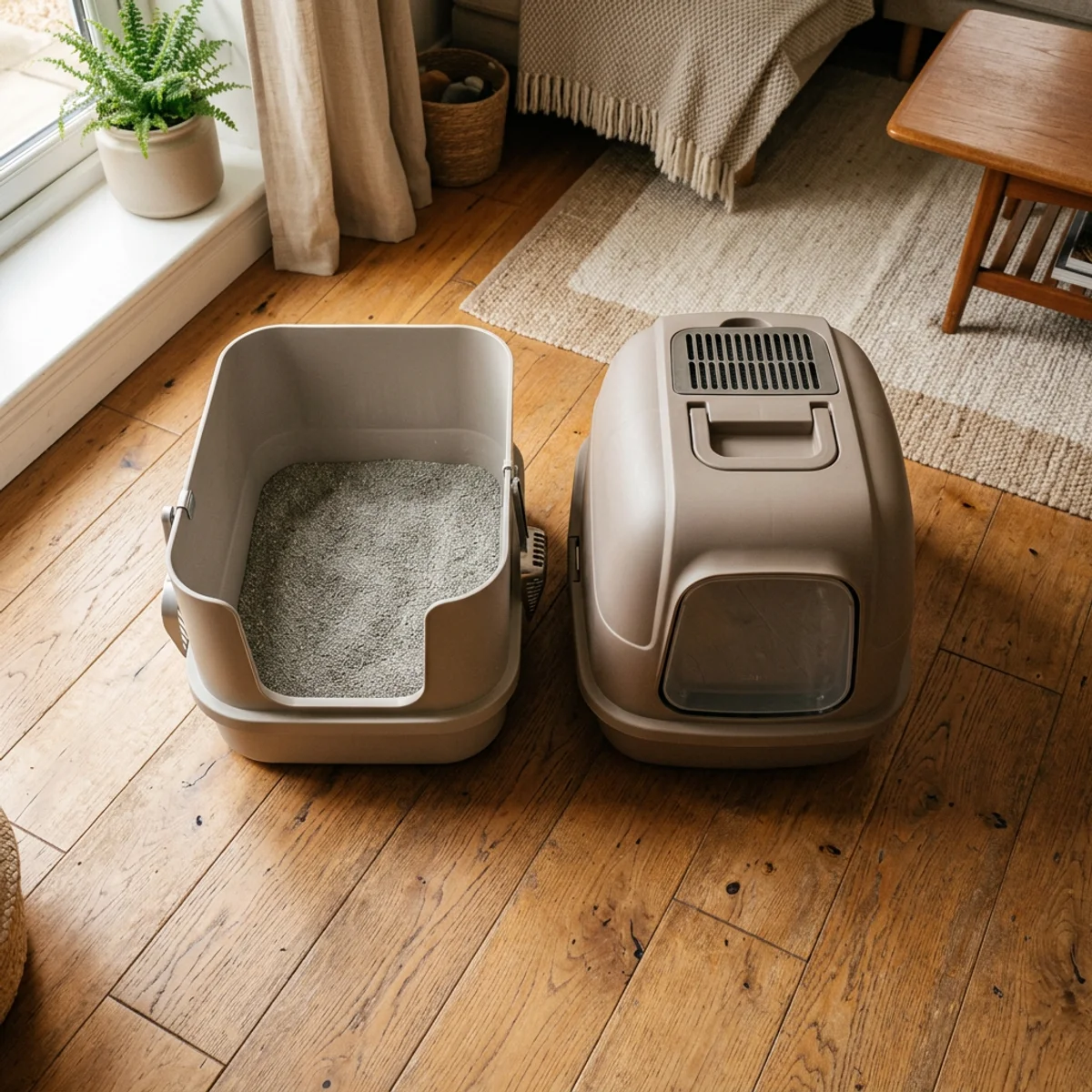
This is where owner preference and cat preference collide. We love covered boxes because they hide the mess and theoretically contain odour. Cats? Most would vote for open every time.
Why Open Boxes Usually Win
Cats are ambush predators and prey animals rolled into one. A covered vs open litter box isn't just aesthetic—it's about security. A covered box is a confined space with one exit, a setup that makes many cats uneasy. If your cat has ever been startled, chased, or cornered by another pet (or a toddler) while in a covered box, she may refuse to use it again.
Open boxes offer:
- Sightlines: your cat can monitor her surroundings while vulnerable.
- Ventilation: ammonia builds up quickly in covered boxes, and cats have scent receptors far more sensitive than ours. What smells "contained" to you may smell suffocating to your cat.
- Easy escape: no door flap to push through, no tight squeeze if she's startled mid-squat.
When Covered Boxes Work
We do keep covered boxes in a few situations:
- Single, confident cats with no history of avoidance sometimes tolerate (or even prefer) the privacy.
- Dogs in the home who treat the litter box like a snack bar. A covered box with a top entry can solve that problem.
- Enthusiastic diggers who fling litter across three square metres. A high-sided covered box—with the lid removed or propped open—gives you splash protection without trapping odour.
If you choose covered, remove any door flap (most cats hate pushing through plastic) and scoop daily. Twice daily is even better. A dirty covered box is exponentially worse than a dirty open one.
Best Litter Box Type: Comparing Your Options
Beyond size and coverage, you'll encounter a bewildering array of styles. Here's how the main categories stack up in real-world use.
| Type | Best For | Drawbacks | Our Take |
|---|---|---|---|
| Standard open pan | Most cats, multi-cat homes, tight budgets | Litter scatter, visible mess | The workhorse. Cheap, easy to clean, and cats actually use them. Start here. |
| High-sided open | Enthusiastic diggers, males who stand to spray | Harder for kittens/seniors to enter | Our go-to for healthy adult cats. Contains scatter without a claustrophobic lid. |
| Covered/hooded | Privacy-loving cats, dog-proofing | Poor ventilation, odour trap, one exit | Use sparingly. Remove door flaps and scoop obsessively. |
| Top-entry | Small spaces, dogs, litter tracking | Difficult for seniors/kittens, hard to scoop, poor ventilation | Clever in theory, problematic in practice. Avoid if your cat is over 8 years old or has any mobility issues. |
| Self-cleaning (automatic) | Single-cat homes, people who travel frequently | Expensive (CAD 300–700+), mechanical noise can scare cats, jams if litter is wrong type/moisture | Luxury, not necessity. If your cat tolerates the sound and you commit to maintenance, they work. But a $15 pan scooped daily works just as well for the cat. |
| Sifting/layered trays | Non-clumping litter users | Doesn't work with clumping litter, extra parts to store | Niche. Most Canadian cat owners use clumping litter, making this system irrelevant. |
We keep standard high-sided open pans for 80 % of the cats in our lives. They're boring, they work, and no cat has ever refused one because it lacked smart-home integration.
A Word on Self-Cleaning Boxes
We've tested three models. They're beautifully engineered and genuinely convenient—if your cat isn't startled by the rake cycle and if you're willing to troubleshoot sensor glitches and clump jams. One of our cats refused to enter the box after watching it cycle once. Another used it happily for two years.
Self-cleaning boxes solve a human problem (scooping), not a cat problem. If you're considering one, introduce it slowly, run a few empty cycles while your cat watches from a distance, and keep a backup traditional box during the transition.
Litter Box Placement: Location Matters More Than You Think
You can buy the perfect box and fill it with premium litter, but if it's shoved in a cold, dark basement corner next to the furnace, your cat may simply opt out.
The Golden Rules of Placement
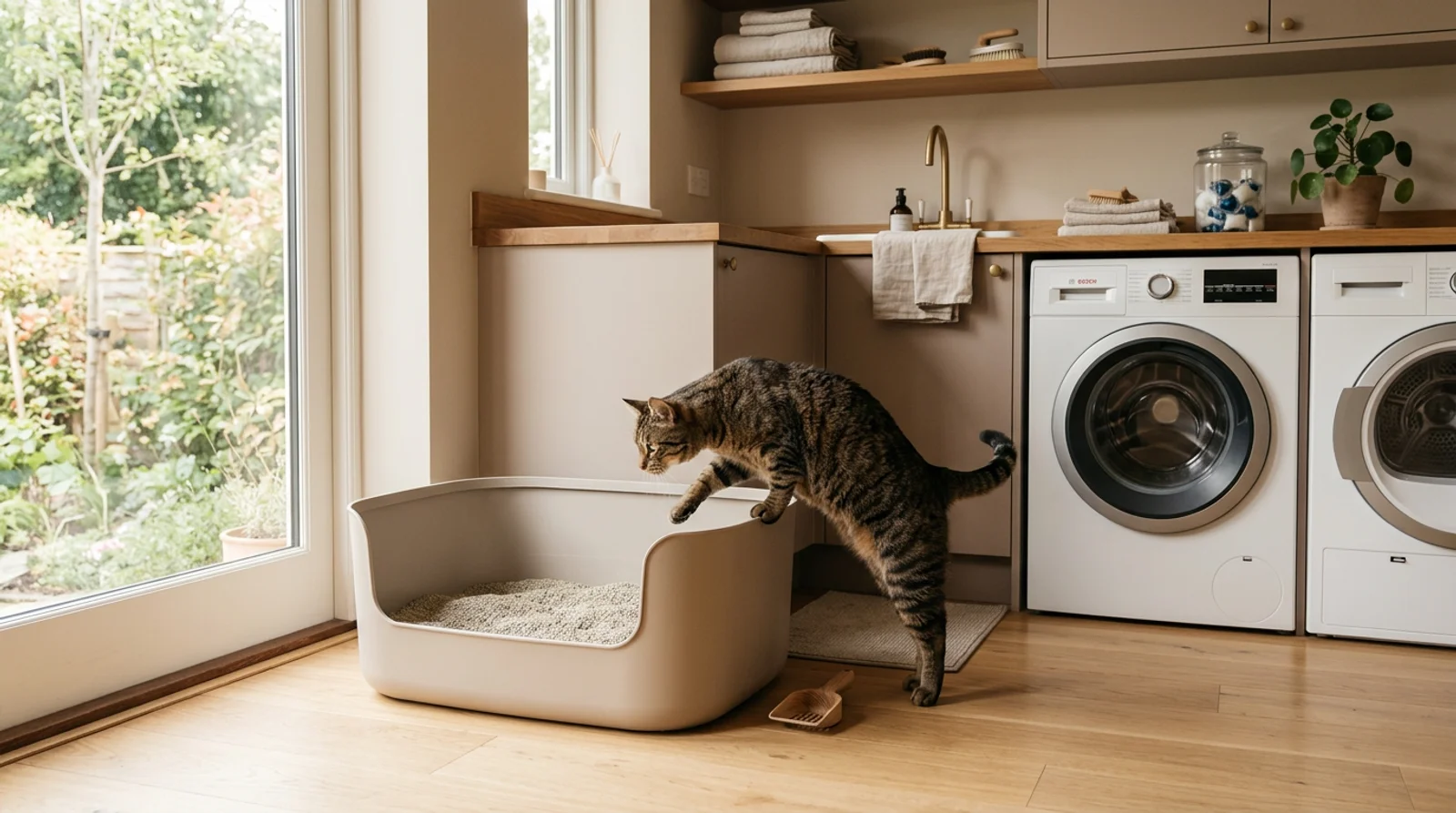
Quiet, low-traffic areas—but not isolated. Cats want privacy without exile. A spare bathroom, a laundry room, or a quiet corner of a finished basement works. A dank crawl space or a busy hallway does not. If you wouldn't want to use a bathroom there, neither does your cat.
One per cat, plus one extra. The classic formula still holds. Two cats = three boxes, ideally on different floors or in different rooms. This prevents territorial guarding and gives a subordinate cat an escape route if the dominant cat blocks access. In our multi-cat home, boxes are spread across two floors—no cat has to pass another's "territory" to reach a box.
Avoid placing boxes near food and water. Cats are hardwired not to eliminate near their food source. Even 2–3 metres of separation helps.
Separate boxes from loud appliances. Furnaces, washing machines, and dryers all startle mid-squat cats. If your laundry room is the only option, place the box as far from the machines as possible and ensure your cat has used it confidently for weeks before running a loud cycle nearby.
Easy escape routes. Never place a box in a dead-end closet or tight nook where a cat can be cornered. If you have a dog, toddler, or second cat who might ambush, position boxes so your cat can exit in more than one direction.
Multi-Level Homes and Aging Cats
If your home has multiple storeys, keep at least one box on each level. A senior cat with arthritis (or a kitten still mastering stairs) won't trek two flights in an emergency. We've seen dozens of cases where a previously reliable 12-year-old cat starts having accidents on the main floor simply because the basement stairs became too painful. Add a box upstairs, problem solved. For more on supporting older cats' changing needs, our senior dog care guide covers similar mobility principles—many apply to senior cats as well.
How Many Litter Boxes Do You Really Need?
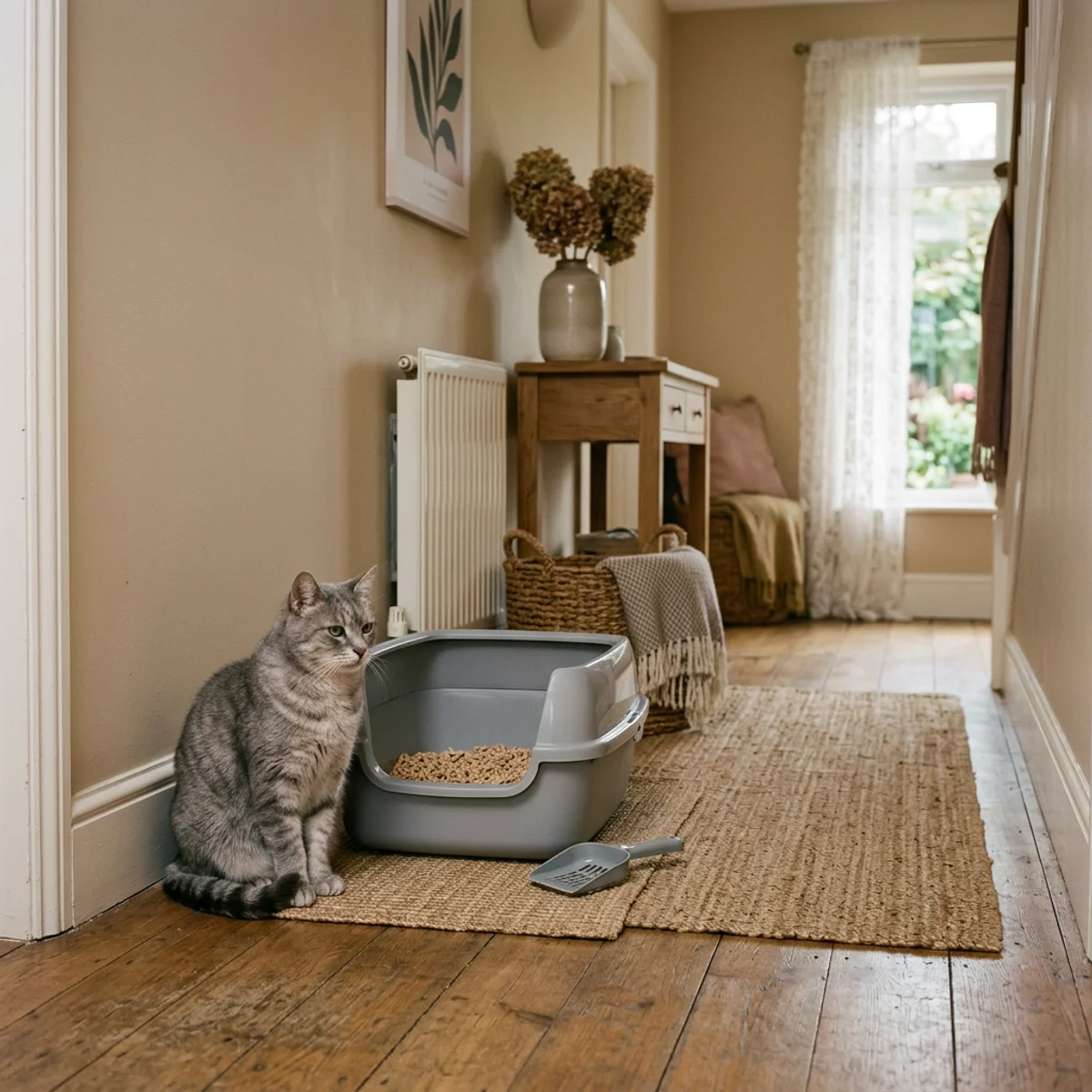
One box is never enough, even for a single cat. The n+1 rule (one box per cat, plus one extra) exists because cats are fastidious and territorial. A cat may refuse to urinate in a box she's just defecated in. Another may avoid a box a housemate has claimed.
In practice:
- One cat: two boxes, in separate locations.
- Two cats: three boxes, spread across at least two rooms or floors.
- Three or more cats: you're running a small colony. Plan for n+1 at minimum, and watch for signs of guarding or avoidance. Some cats will need their own dedicated box.
This sounds excessive. It's not. The cost of an extra $15 litter pan is trivial compared to the cost—financial and emotional—of treating chronic stress-related cystitis or cleaning urine out of your sofa. If your cat is showing signs of stress, litter-box access and placement should be the first things you audit.
Litter Box Maintenance: Cleanliness Is Non-Negotiable
Even the best box will fail if it's not maintained. Cats have 200 million scent receptors (we have 5 million). A box that smells "fine" to you may smell like a gas-station restroom to your cat.
Scoop daily. Twice daily for multi-cat homes or small boxes. This is the single highest-impact habit.
Full litter changes every 2–4 weeks, depending on litter type and number of cats. Clumping litter lasts longer than non-clumping, but even clumping litter breaks down and holds odour over time.
Wash the box with mild, unscented soap monthly. Skip the bleach and harsh cleaners—residual scent can deter cats. Hot water and dish soap are enough. Dry completely before refilling.
Replace plastic boxes every 12–18 months. Plastic scratches, and those scratches harbour bacteria and odour no amount of scrubbing will remove. When your boxes start looking hazy or smelling musty even after washing, it's time.
For a deeper dive into setup and upkeep, our full litter-box setup and maintenance guide walks through litter depth, liner pros and cons, and troubleshooting common issues.
Special Considerations: Kittens, Seniors, and Cats with Mobility Issues
Not every cat fits the standard profile. Adjust your box choice to match your cat's life stage and physical needs.
Kittens need low entry sides (under 10 cm) until they're fully coordinated, usually around 4–5 months. Use a standard adult-sized box with one side cut down, or buy a shallow puppy-training tray for the first few weeks. Just don't stick with it—kittens outgrow shallow boxes fast.
Senior and arthritic cats struggle with high sides and jumping. Look for boxes with a low entrance (or cut one yourself with a utility knife and sand the edge smooth). Top-entry boxes are completely inappropriate for any cat over eight or with joint issues. If your senior cat starts eliminating just outside the box, especially near the entry, pain is a likely factor—check with your vet and lower the threshold.
Overweight cats need both extra space and lower sides. A 7 kg cat simply can't contort herself in a 40 cm box. Go large, go open, and place it somewhere she can approach without jumping or squeezing.
Cats with chronic illness (diabetes, kidney disease, arthritis, cognitive decline) may need boxes on every floor, with night-lights for navigation and even puppy pads nearby as insurance. This isn't "giving up" on the litter box—it's acknowledging that a sick or elderly cat's body may not give her enough warning to make it to the basement. Compassion and pragmatism win here.
FAQ
How big should a litter box be for my cat?
At minimum, 1.5 times your cat's body length (nose to base of tail). For an average adult cat, that's 65–70 cm long. Larger cats—Maine Coons, Ragdolls, or any cat over 6 kg—need boxes 75–90 cm or bigger. When in doubt, bigger is always better. Cats never complain that a box is too spacious.
Do cats prefer covered or open litter boxes?
Most cats prefer open boxes because they offer better ventilation, sightlines, and escape routes. Covered boxes trap odour and make cats feel cornered. If you choose a covered box, remove the door flap, scoop at least twice daily, and watch for avoidance. If your cat suddenly stops using a covered box, try switching to an open one for two weeks—you'll often see the problem resolve immediately.
Where should I put the litter box in my house?
Choose quiet, low-traffic areas away from food, water, and loud appliances. Cats need privacy but not isolation—avoid dank basements or dark closets. Place at least one box per floor in multi-level homes, and ensure your cat can escape in more than one direction (never box her into a dead-end corner). For small homes or apartments, see our small-space solutions for pet owners for placement ideas that work.
How many litter boxes do I need for two cats?
Three. The formula is one per cat plus one extra. This prevents territorial blocking and gives each cat a clean option. Spread the boxes across different rooms or floors so one cat can't guard all the resources. Even bonded siblings benefit from multiple, separated boxes.
Finding the Right Fit for Your Cat
The litter box you choose shapes your cat's daily comfort and your home's cleanliness. It's one of the few pieces of pet gear where function genuinely trumps form—and where skimping or guessing wrong costs you in accidents, stress, and vet bills.
Start with a large, open, high-sided pan in a quiet spot your cat can access easily any time of day. Add a second box in a different location. Scoop daily. If your cat is happy, you're done. If she's avoiding the box, work backward through size, style, placement, and cleanliness before assuming it's a medical or behavioural issue. More often than not, the fix is simpler than you think.
Browse our full range of thoughtfully curated litter solutions and accessories designed to make life easier for both you and your cat—because the right setup really does change everything.